R&D Insights

Measuring Risk in R&D

The Problem

It is no secret in the biopharmaceutical industry that a new drug’s clinical improvement is strongly predictive of the share of patients it achieves. Consequently, drugs that offer little clinical improvement expose developers to commercial risk.

Many organizations, while aware of this problem, continue to lack a proven methodology to identify and quantify that risk. This exposes them to the possibility of advancing undifferentiated drugs that will experience low market access and vulnerability to future competition.

The Solution

Equinox Group has quantified the relationship between clinical improvement and patient share by comparing the magnitude of improvement delivered vs. share achieved in the real world in a large set of historical drug launches. Clinical improvement reflects advances in efficacy, safety, tolerability, dosing, and patient outcomes. Our metric for clinical improvement includes all of these domains and measures the percent reduction in medical need the new drug offers relative to the standard of care. We call that measure of improvement  “Clinical Innovation”.

Measuring Clinical Innovation: A Data-Driven Approach

For 30 years, Equinox Group has used a validated, data-driven approach to measure the clinical innovation offered by new drugs across hundreds of indications. See this two-minute video explanation:

The Link to Commercial Potential

Over many years we have re-evaluated the relationship between clinical innovation and patient share; it has been remarkably stable over time. Below is a table of historical drug launches and where they score in the Equinox Group framework.

As a rule of thumb,

  • High Innovation: Drugs that offer 10% or more clinical innovation nearly always dominate the branded segments of their markets.

  • Medium Innovation: Drugs with 5% to 10% innovation usually compete well.

  • Low Innovation: Drugs with 0-5% improvement are in a gray zone and may be seen as undifferentiated, especially by payers.

  • Lack of Innovation: Drugs with negative clinical innovation nearly always get low patient shares and disappointing sales.

How Much Clinical Innovation is Enough?

The clinical attributes anticipated in early R&D programs are rarely realized by the end of development. As time goes on, assets often acquire “warts,” whether it be unexpected side effects, lower than expected efficacy, or both. Programs that start with modest clinical aspirations are likely to offer unacceptable levels of innovation at launch.  We call this phenomenon “attribute drift.”

We recommend that drug development teams aim to achieve clinical innovation of at least 5% to reduce exposure to attribute drift and the commercial risks described in the beginning of this paper. Our tools allow teams to tie the expected clinical attributes of a new drug first to its level of clinical innovation, and then to patient share to forecast revenue potential.

The Take-Home

Equinox Group’s proven method to measure clinical innovation and predict peak-year patient share for target product profiles is accurate.  It’s also less expensive, more flexible, and quicker to execute than conventional market research-based techniques.  We use this approach to inform decisions about individual programs (pipeline and BD), to help therapeutic area teams set aspirations, and to inform R&D portfolio assessments.

Who Are We?

Since 1995, Equinox Group has provided analytics to support R&D decisions at biopharmaceutical firms, assessing the potential of drugs from discovery to launch. Our validated techniques will save you time and money, as well as overcome the deficiencies of traditional market research.

We have evaluated thousands of drug profiles across hundreds of indications in oncology, immunology, rare diseases, cardio-metabolic disorders, infectious disease, neurology, pulmonology, urology, ophthalmology, and endocrine disorders. We also have tailored methods to solve the unique analytical challenges that arise in oncology and rare diseases.

Using this methodology, we have developed a suite of tools to inform whatever R&D decisions you’re facing in any stage of development, including: setting indication priorities, supporting go/no-go decisions, assessing market access and pricing potential, share forecasting, and patient flow modeling.

How Equinox Group Models Drugs in R&D: The Case of Alecensa in 1L ALK+ NSCLC

We routinely share our view of new drugs coming to the market; for instance, a few months ago, we posted an article detailing top-line results of an analysis of Enhertu in 1L HER2+ metastatic breast cancer.

This article shows in detail how Equinox arrives at a peak share estimate for a new drug treatment, using the example of alectinib (Alecensa, Roche/Genentech) in 1L ALK+ non-small cell lung cancer (NSCLC). Alecensa was approved in this indication 8 years ago; we’ll show how our methodology predicted it would achieve 60% peak share using publicly available data and our Disease Target Assessment framework.


The Framework

Equinox Group’s Disease Target Assessment (DTA) model quantifies the level of medical need in the target population based on peer-reviewed literature. This framework characterizes the adequacy of the current and possible future standards of care (SOCs) to serve as a benchmark for evaluating client product profiles.

We start by characterizing unmet medical need within each defined patient population, quantifying unmet needs in these product attributes:

  • Efficacy

  • Safety/tolerability

  • Dosing

  • Price

as well as key elements of the burden imposed by the disease:

  • Mortality

  • Morbidity (pain, chronic disability, hospitalization, and HRQOL)

  • Non-drug health care costs

For each domain and subdomain, we use consistent utility functions to derive a score on a 0-5 scale (with 0 representing no unmet need and 5 substantial unmet need). Each domain has a fixed weight based upon its importance, as verified through regression analysis of launched agents. The sum of the weighted scores measures the total unmet medical need for patients treated with the profiled therapy.

Through validation against actual market performance, Equinox has demonstrated that the Clinical Innovation of a new drug (or regimen) offers reliable insight into its ability to compete. A few rules of thumb hold up surprisingly well in projecting a new drug’s commercial outlook:

  • Drugs with 10%+ Clinical Innovation nearly always dominate their segments – we consider agents with 10%+ Clinical Innovation to be highly innovative

  • Drugs with Clinical Innovation between 5% and 10% typically achieve good patient share – they are moderately innovative

  • Drugs with Clinical Innovation below 5% are typically seen as poorly differentiated, especially by payers – these drugs have low innovation

Clinical Innovation and competitive intensity are key drivers of share; our DTA models enter these two inputs into an algorithm derived from a regression analysis of actual market performance to estimate peak-year patient share. Comparing our share predictions to observed peak-year shares, Equinox Group’s oncology-specific regression has a strong R-squared value of 83%.

The DTA methodology is rigorous and dynamic. The Excel-based model we deliver allows for instantaneous updates of inputs and outputs. All sources are well-documented in comments throughout the model, with a bibliographic sources sheet included as well.

Key steps in an Equinox DTA Project

  1. Define the distinct patient population(s) of interest

  2. Characterize disease burden within each patient population

  3. Identify and characterize standard(s) of care

  4. Model the market entrant/TPP

  5. Analyze the developmental pipeline to quantify the expected future level of competition

  6. Estimate the number of addressable patients in the US and key European markets

To support the modeling, Equinox Group also conducts a handful of interviews with academic medical experts to explore their views on pipeline agents, treatment paradigms, and key unmet needs.


The Clinical Sheet

Equinox Group begins by characterizing the key clinical attributes of the SOC(s). We can then use an identical rule set to model client TPPs. For clients who do not yet have any TPPs, we can help model plausible scenarios for profiles.

In 1L ALK+ NSCLC, the SOC prior to alectinib was crizotinib. (Models normally carry two extra slots to model alternative or future SOCs as needed.)

The key clinical domains are shown in the figure below.

Starting in the efficacy domain, we enter peer-reviewed clinical data for the SOCs. Client TPPs are judged along the same lines. In oncology, key efficacy inputs are:

  • overall survival,

  • progression-free survival, and

  • response rates (partial, complete, and overall)

All inputs are explained in accompanying comments within the Excel file. Academic literature is clearly cited, and any necessary assumptions are explained.

Key safety data are gathered from SOC labels and relevant published trials.

Boxed warnings, frequent or inconvenient patient monitoring, and contraindications and pregnancy warnings (when appropriate) are all taken into account.

Grade 3/4 adverse events are modeled and individually weighted based on their severities (e.g., hyponatremia has a lower impact on unmet need than neutropenia). When substantial adverse event data/hypotheses are available for a TPP, we can model the rates of each event. Alternatively, we can model a simple percentage improvement over a comparator profile (e.g., 20% reduction in the rate of each AE seen in the crizotinib side effect profile). In the example below, full side effect data were available.

The drug or regimen’s convenience score is calculated via a consistent method. Common dosing methods, frequencies, and locations are pre-populated in drop-down menus. The model allows for multi-drug regimens to be modeled, even when combining IV and oral therapies. In this example, each profiled drug is an oral monotherapy.


Finally, the drug or regimen’s annual cost is calculated using U.S. WAC pricing. We use WAC values because they allow fair, transparent comparisons and because net prices are not widely visible.

When patients are on treatment for less than one year, the cost calculation is restricted to time on treatment. In the example below, median time to progression is 10.9 months, so only that fraction of the year is entered in “intended days of therapy”.

The Unmet Need Sheet

The data from the Clinical sheet flow into the Unmet Need sheet (see below); the core clinical assumptions each have their own sub-domain under product need.

Equinox Group staff gather peer-reviewed data on disease burden (disease seriousness and disease cost), and the consistent utility functions are applied in Excel.

Baseline disease seriousness and costs values come from relevant academic literature, and improvements in efficacy flow through to reduce need in these domains.

In this example, alectinib is more efficacious (thus the lower Efficacy score) and has a cleaner side effect profile than crizotinib. Despite a minor convenience disadvantage, its product need score is significantly lower.

The advantage in overall survival is reflected in a lower mortality score.

Advantages in progression-free survival and response rates reduce morbidity, indirect costs, and non-drug direct costs.

These benefits in indirect and non-drug direct costs partially offset alectinib’s higher price.

The weighted sum of these domain-specific unmet need scores equals a product’s total unmet need score. Overall, total unmet need is lower with alectinib than with crizotinib in 1L ALK+ NSCLC, indicating a better therapeutic option.

Drivers of Innovation

We call the reduction in total unmet medical need is called "Clinical Innovation". We graphically display Clinical Innovation using a Drivers chart.

The gold bars to the left and right of the chart represent the unmet need score under the SOC (crizotinib) and entrant (alectinib), respectively.  Scores range from 0-5 with 0 representing no unmet need. As with any waterfall chart, the intermediate green and red bars represent improvements and detriments, respectively, in domain-specific unmet need.

In the above figure, alectinib is shown to reduce total unmet medical need by 23.2%, with more than two-thirds of its improvement coming from efficacy advantages, and its direct cost impact clawing back <1% of its Clinical Innovation. (The percentages on the chart show the contribution of each domain to that 23.2% overall improvement.)

The Clinical Innovation score of 23.2% is highly impressive. Recall our rules of thumb: products with unmet need improvements of >2% are typically commercially viable, >5% are commercially successful (top 3-4 in market), and >10% are market dominators.

The Competitive Environment

Equinox conducts a thorough review of the developmental pipeline using publicly available sources, such as clinicaltrials.gov and sponsor websites. This pipeline is reviewed by physician experts to ensure nothing is missed, and client competitive intelligence is welcomed.

Each pipeline agent is assigned a probability of launch based upon its phase of development and recent data on success probability by phase and therapeutic area. Competitors are also assigned an angle of impact – how directly (25%-100%) will the entrant and the pipeline agent compete with each other?

We call the sum product of these factors “Competitive Intensity”, a probabilized headcount of competitors the entrant will face at launch. A competitive intensity rating of 319%, as shown below, is roughly comparable to three direct competitors at launch.

The Commercial Sheet

Seeing a profile’s projected peak-year share is as simple as one click. Selecting the SOC at launch in the blue cell will automatically update the profile’s clinical innovation score which, alongside competitive intensity, are entered into the Equinox Share Predictor. The Commercial sheet also displays key figures such as unmet need scores with the SOC and entrant, diagnosed prevalence of the indication in the U.S., and the annual cost of the profile.

Given a Clinical Innovation score of 23.2% and a competitive intensity rating of 319%, Equinox Group’s regression-validated algorithm projects a peak-year patient share of 60% for alectinib in 1L ALK+ NSCLC.

Each entrant’s share call compares its unmet need score to that of a chosen SOC and factors in the estimated number of competitors at launch. In this example, product attributes for potential new competitors are not evaluated in calculating peak share. As a further product offering, Equinox builds forecasts that capture the impact of competing entrants’ clinical attributes and launch timing to produce realistic forecasts of share over time.


Conclusion

The easy-to-use Excel-based DTA model allows clients to war-game scenarios for input values that aren’t certain yet (such as mature overall survival data) and instantly see how those alternatives affect Clinical Innovation and patient share estimates.

Interested in learning more? Click here to send us a message or to schedule a meeting with one of our practice leaders.

Equinox Group’s proven method to measure clinical innovation and peak-year patient share for new products is accurate, less expensive, more flexible, and quicker to execute than conventional market research-based techniques. We use this approach to inform decisions about individual programs (pipeline and business development), to help therapeutic area teams set aspirations, and to inform R&D portfolio assessments.

A project of this nature typically delivers results in around 6 weeks. We support our models for 24 months from kickoff and can help socialize the methodology and results within your organization.


About Equinox Group

Since 1995, Equinox Group has provided analytics to support R&D decisions at biopharmaceutical firms, assessing the potential of drugs from discovery to launch. Our validated techniques save time and money—and they overcome several deficiencies of traditional demand studies.

We have evaluated thousands of drug profiles across hundreds of indications in oncology, immunology, rare diseases, cardio-metabolic disorders, infectious disease, neurology, pulmonology, urology, ophthalmology, and endocrine disorders. We also have tailored methods to solve the unique analytical challenges that arise in oncology and rare diseases.

Using this methodology, we have developed a suite of tools to inform whatever R&D decisions you’re facing in any stage of development, including: setting indication priorities, supporting go/no-go decisions, assessing market access and pricing potential, share forecasting, and patient flow modeling.

What indications should we focus on?

Drugs with utility across multiple patient populations have the potential to become major cash cows for biopharmaceutical companies. To tap this potential, companies must carefully select which indications to prioritize. This decision can be the difference between establishing a new brand that becomes a pillar of a company’s success and having consistently underperforming sales. The ideal choice is one where high medical need exists in a sizeable population, the asset promises to offer significant improvement, and there is relatively low competition. (Probably no indication checks all of these boxes perfectly.)

Equinox Group provides analytical decision support to development teams making indication prioritization decisions by quantifying these characteristics for each opportunity.

Figure 1 shows how key commercial factors compare across candidate indications for a new oncology therapy, which we call Product X.  Perhaps the most important of these—and the hardest to characterize consistently—is the level of improvement the drug would offer over the standard of care (SOC), a chief driver of patient share (more on share below).

We use a rigorous technique to quantify that improvement, which we call “Clinical Innovation”. Using real world market performance, we have observed that the following general rules hold up remarkably well:

  • Drugs with 10% or greater Clinical Innovation typically dominate their segments

  • Drugs with 5 to 10% Clinical Innovation achieve good patient share

  • Drugs with less than 5% Clinical Innovation typically struggle; they impose high risk on the developer

Figure 1: Clinical Innovation, Population Size, and Medical Need: A New Drug in 8 Indications

Product X is highly innovative in 2L CRC (a large population), as well as in 2L TNBC and 1L ALK+ NSCLC.  It is also moderately innovative in 1L and 2L melanoma, and 2L pancreatic cancer.  In 2L prostate cancer, however, the drug’s Clinical Innovation is well below the 5% threshold, suggesting Product X will be approvable but not be highly competitive in this population.  In 3L melanoma, Product X’s Clinical Innovation is slightly below the desired 5% mark, but approval here may be helpful in pursuing 1L and 2L, larger patient segments where Product X is more innovative. These indications have moderate-to-high need at baseline, forming two tight groups on the high end of our unmet need scale.

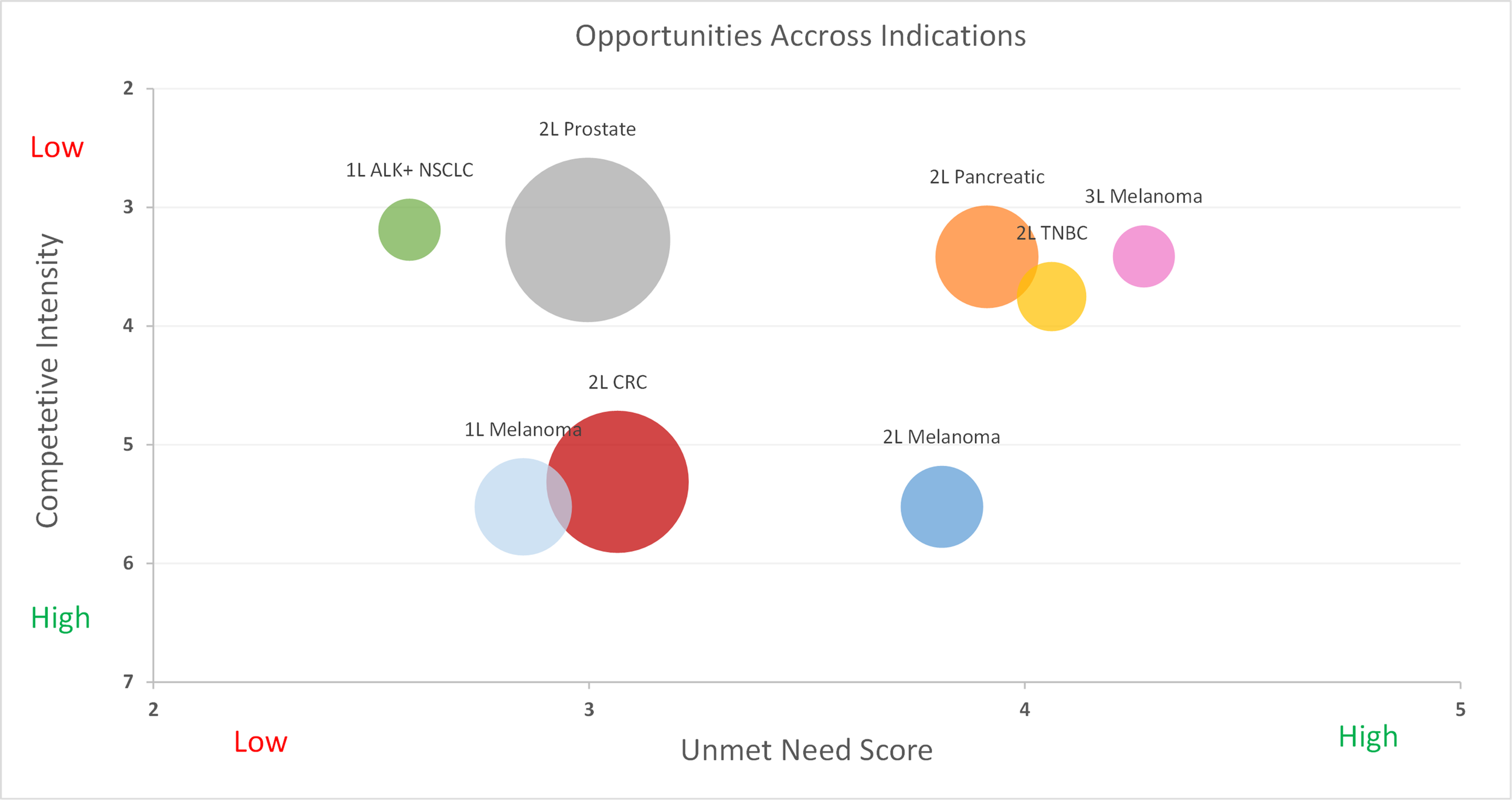
With all of this in mind, we can transform our view to consider the competitive intensity in each population rather than the level of unmet medical need under the SOC. Below in Figure 2, indications are located by the competitive intensity faced by Product X as well as clinical innovation, with bubble size still indicating patient population size. Note that a lower score on the y-axis implies less competition, meaning that in indications located in the upper right, Product X offers high clinical innovation and has low competition.

Figure 2: Clinical Innovation, Population Size, and Competitive Intensity: A New Drug in 8 Indications

As we can see, the indications are once again separated into two groups: those with moderate competitive intensity (3 to 4 expected direct competitors at launch) and those with higher competitive intensity (5 to 6 competitors).

Additionally, Equinox has developed a regression equation that predicts peak-year patient-share as a function of two of the factors described here; the level of Clinical Innovation and the number of competitors.

Table 1 gathers the key commercial factors presented above into one view, including the corresponding peak-year patient share estimates in the indications.

Table 1: The Complete View

*Undifferentiated from SOC

From our assessment of the clinical innovation in each indication, it is already clear that 1L ALK+ NSCLC, 2L CRC, and 2L TNBC offer good commercial opportunities. But which of them is the best? And what about all the others? Taking into account the other commercial factors, we notice that while 1L ALK+ NSCLC faces moderate competition and has the highest clinical innovation, it ranks as the smallest population with the lowest unmet medical need. Therefore, it’s not going to provide the best revenue potential. Likewise, in 2L TNBC, there is a relatively low barrier to entry and a high unmet need, but the population size also restricts potential gains.

In 2L CRC, the moderate unmet need and large population size make it the best opportunity among the eight indications. While the competitive intensity is high, a clinical innovation of 11.3% should adequately insulate Product X from the competition and results in significant patient share in a sizable population. Due to its size, an initial approval in this indication will potentially help the asset owner manage development costs in the other indications.

These three indications (ALK+ NSCLC, 2L TNBC, and 2L CRC) also have the potential to create a “halo effect” where payers and prescribers view Product X more favorably in other indications due to its previous success. This may prove helpful when pursuing 1L & 2L Melanoma and 2L Pancreatic, all of which are valuable opportunities in this assessment. All things considered, Product X offers substantial revenue and growth potential, if managed properly.

Finally, the analytics described here also include a basis for comparing pricing potential across the candidate indications. To keep this introduction to the techniques brief, we have not included that analysis here, but for those interested in how a pricing potential assessment can be added to the outputs, see this example.


We have fine-tuned these methodologies and others over the past 30 years to help biopharmaceutical companies handle challenges in R&D. Our specialties range from market access and go/no-go decisions to patient share forecasting and patient flow modeling. To learn more about our process, click here to schedule a meeting with one of our practice leaders.

Comparing Opportunity Across Subpopulations: Rozlytrek as a Case Study

Medical need and the opportunity to reduce it can vary widely across patient segments within a tumor type.  Analyzing those differences can help development teams gain meaningful insights into the range of commercial opportunities across segments.   

Roche’s targeted cancer drug Rozlytrek was approved in August 2019 for metastatic non-small-cell lung cancer (NSCLC) patients whose tumors are ROS1-positive. ROS1 rearrangements present in just 1-2% of NSCLC patients, and a little over one third of these patients develop brain metastases. By analyzing the published clinical data in Equinox Group’s modeling framework, we conclude that:

  1. The level of medical need in patients with brain metastases is considerably higher than it is in the writ-large ROS1-positive population, and more importantly

  2. Rozlytrek’s clinical improvement in ROS1-positive patients with brain metastases is substantial, while among the writ-large population the improvement is modest

Comparing the Level of Medical Need in Two Populations

The chart below compares unmet medical need (as measured in Equinox’s model) for the two populations when treated with Xalkori, which was the standard of care for ROS1-positive patients before the approval of Rozlytrek. Patients with brain metastases have 24% higher medical need than the writ-large population.  As the chart shows, higher need in the brain metastases population is driven by inferior efficacy and worse mortality outcomes.

Two indications.PNG

Comparing Rozlytrek’s Clinical Improvement over Xalkori in Each Population

When we model Rozlytrek against Xalkori in the writ-large ROS1-positive population, we find little difference in efficacy between the two agents. Rozlytrek’s overall clinical innovation (mostly attributable to safety/tolerability) is only 1.3% in this broader group; historically, drugs with less than 5% clinical innovation are seen as undifferentiated.

Writ large drivers.PNG

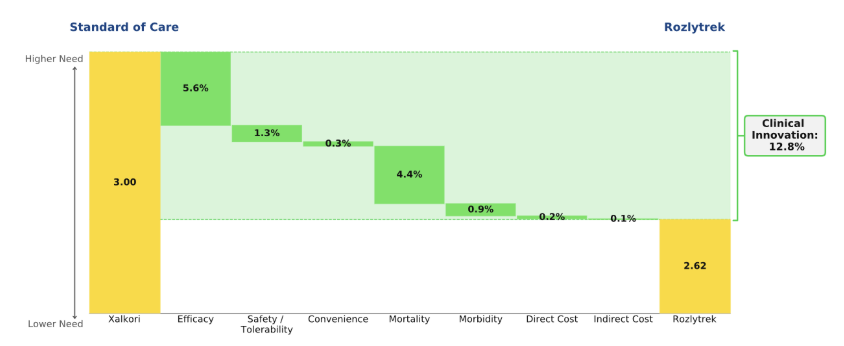
However, when we restrict the analysis to patients who have brain metastases, Xalkori is less effective and Rozlytrek achieves an impressive clinical innovation score of 12.8% (drugs with clinical innovation above 10% usually dominate their branded segments).  The far greater overall improvement in patients with brain metastases is attributable primarily to over 3 months greater mPFS (we assume mOS changes are proportional, as those data were not mature at publication).

brain mets drivers.PNG

Rozlytrek’s efficacy in cancer that has spread to the brain is an important advantage over Xalkori that is clearly illustrated only when we model the appropriate subset of ROS1-positive NSCLC patients. And while both the writ-large and brain metastases population analyses provide useful information on their own, examining them side-by-side sheds further light on the sources of advantage for the asset in this tumor.

Finding the Right Price for a Drug across Multiple Indications; Learnings from Keytruda

Previously, Equinox has described a hypothetical exercise in which a development team attempts to find an optimal price for an agent that is in development in multiple indications.

Here we repeat this exercise with a real-world example, Keytruda.

Keytruda has been approved for a variety of indications.

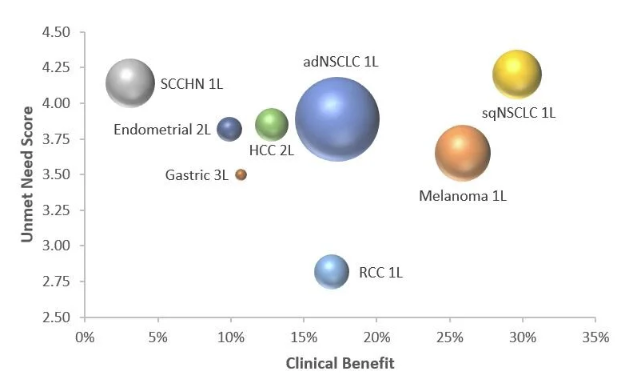
These indications differ in the size of the addressable patient population (bubble size), the level of unmet need (y axis) and, most importantly, the degree to which Keytruda delivers benefit to patients (x axis).

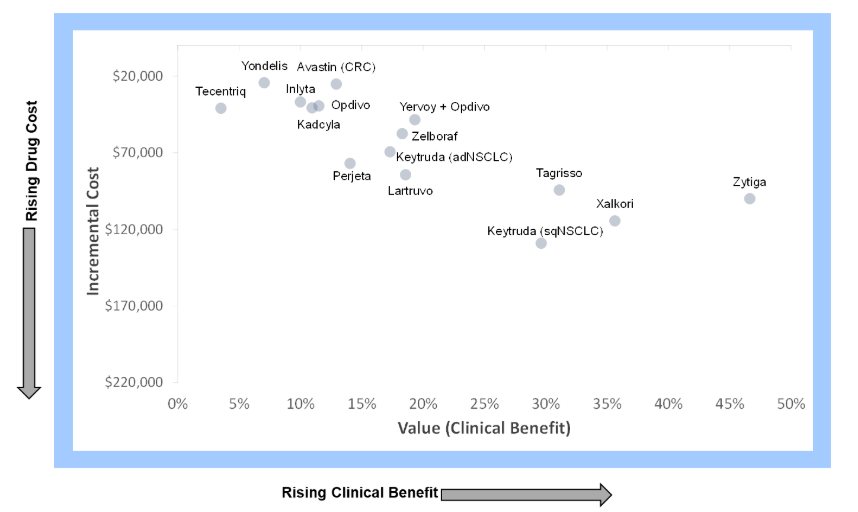
Finding the right price-per-vial across diverse indications is challenging. Equinox’s analytical tools allow product teams to quantify the value delivered in each population. When we plot the incremental clinical benefit delivered against incremental cost for successful agents, we see the following “cloud” relationship:

CvB without Keytruda and arrows.jpg

Each point represents a new agent in a specific patient population.

Equinox predicts that emerging agents that map within this cloud will receive favorable reimbursement, but agents that land below the cloud risk significant push-back from payers in those indications. Points above the cloud represent indications where the agent is under-priced.

Compared to these exemplars, Keytruda’s various indications map as follows:

CvB with Keytruda.JPG

Keytruda’s price appears appropriate for Gastric, Head and Neck, and Lung Cancer. As a consequence, it offers poor value for money in RCC and Endometrial, and leaves money on the table in HCC and Melanoma. Overall, the price point appears optimized.

Equinox’s analytical tools allow product teams to assess the trade-offs inherent in arriving at a price for any agent in development for multiple indications.

How to Price an Oncology Drug

It is widely agreed that drugs should be priced to reflect their value, or clinical benefit.  But how does one measure clinical benefit?  Equinox Group uses a proven method to quantify clinical benefit, derived from our deep experience in assessing unmet medical need.

A new drug’s proposed cost (on Y-axis, inverted scale) should align with its promised clinical benefit (on X-axis) to place it in the “cloud” of successful recent launches.

A new drug’s proposed cost (on Y-axis, inverted scale) should align with its promised clinical benefit (on X-axis) to place it in the “cloud” of successful recent launches.

Locating clinical benefit on a specific scale allows us to examine how benefit is related to drug price in many recent launches that have gained good market access. Our analysis of drugs that have achieved favorable market access shows a clear relationship between cost and benefit. That observation allows us to advise companies on appropriate pricing for their emerging oncology agents.

Our measure of clinical benefit reflects efficacy, safety/tolerability and dosing, and how efficacy affects disease burden – mortality, morbidity, and cost. 

We can model the expected attributes of a new agent against the background of disease burden in a specific patient population to test the clients’ desired price for the asset.   We can plot the results on the graph above to determine if the new drug falls within “the cloud” of successful agents.  If it does, the drug will most likely achieve favorable market access at the desired price. If not, a rethinking of the pricing strategy may be called for. Our analysis can be applied to the US and each of the five major EU countries, and the same framework can deliver estimates of peak-year patient share and revenue.

Clinical benefit and drug cost vary by patient segment because of duration of treatment, disease seriousness, and a host of other factors, so we analyze each target indication separately. That way, agents with potential in multiple populations can be analyzed in each indication to find the optimizing price for the asset across the board.