Disease Area Strategy

Finding the Best R&D Opportunities

R&D leaders making investment decisions must rely on opportunity assessments from program advocates. Equinox Group offers independent analyses that allow decision makers to add an objective perspective to these discussions, leading to a fact-based conversation about the clinical and commercial merit of the various projects competing for R&D resources.

“But I don’t have TPPs, what can I do?”

We spend much of our time talking with clients about how good their TPPs look and what patient shares they can expect to achieve in order to guide indication prioritization. To read a case-study on how we do this, click here.

But what can we do for you if you don’t have TPPs yet?

The answer is a two-step process, which we call Disease Area Scan. First, we characterize the unmet medical need, epidemiology, and competitive intensity in all of the populations of interest. This allows for cross-indication comparisons that help identify which opportunities offer the greatest potential for commercial success. Next, we examine each of those opportunities individually, discovering what level of improvement is required in specific product attributes in order to achieve a certain level of Clinical Innovation and peak-year patient share. These analyses are grounded in peer-reviewed literature and hard clinical data, removing subjectivity and opinions from the equation.

Step 1: Characterizing unmet medical need, epidemiology, and competitive intensity

We begin our modeling process by diving into the most recent peer-reviewed literature pertaining to each indication, quantifying the level of unmet need under the current standard of care. See Figure 1 for a detailed breakdown of what we measure.

Figure 1: Factors we assess

These measures are then mapped onto a 0 to 5 scale to produce a single “unmet need score,” with a higher score indicating a higher level of unmet medical need.

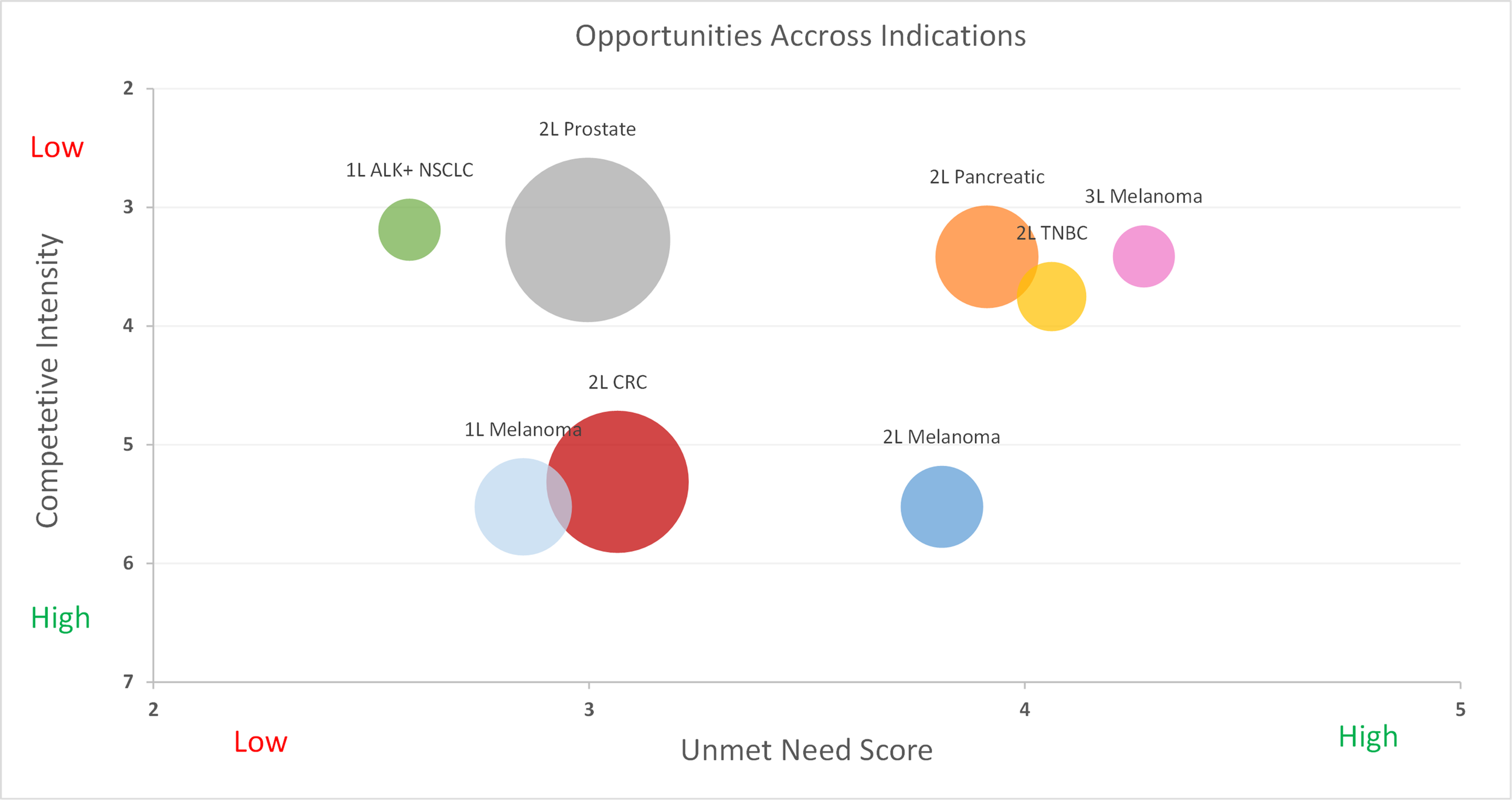
Next, we align with the client organization on the epidemiology and competitive pipelines in each indication. We represent the latter by a probability weighted score indicating the expected number of head-to-head competitors that a drug will face at launch. We call this the “competitive intensity.”

Figure 2: Competitive intensity vs. unmet medical need

Looking at Figure 2, we can identify the most attractive opportunities, which are those with sizeable populations, considerable unmet need, and relatively low competition. Granted, two questions still remain. First, how would the specific drug need to perform in these populations in order to be successful? Second, in what indications do you realistically believe that you can achieve that performance?


Step 2: Using Heat Maps

In order to answer these questions, we can turn to a series of heatmaps, which guide development teams in understanding what levels of Clinical Innovation are achieved by specific efficacy and side effect profiles. Below in Figure 3, we will explore a situation where the current standard of care is pembrolizumab with a median progression-free survival of 6.9 months. We see that an improvement of 1 month in mPFS and a similar side effect profile will result in a 4.6% Clinical Innovation, which is slightly below the recommended 5% threshold. However, if the new drug also offered a side effect profile similar to that of crizotinib, it will achieve a 5.8% Clinical Innovation and likely have a favorable commercial outlook. (For this analysis, it was assumed that an improvement of one month in mPFS also led to an improvement of two months in mOS)

Figure 3: An introduction to heat maps

By focusing on relative improvements under the Equinox framework, development teams are able to identify indications where their agent has the potential to be competitive (those where Clinical Innovation 5-10%) and those where it could be a homerun (Clinical Innovation >10%). In situations where the clinical team is not ready to commit to specific efficacy values for their TPPs, this approach allows teams to prioritize those indications where they are more confident of “getting into the green”. These heat maps can be generated for a variety of attributes, allowing for a comprehensive and thorough analysis of potential products that projects a variety of scenarios. 

What About Share Potential?

While Clinical Innovation is a powerful predictor in itself, we don’t have to stop there. Combining the clinical innovation scores of hypothetical TPPs along with the corresponding competitive environment, unmet need, and epidemiology allows for the preliminary estimation of peak-year patient share using our Disease Target Assessment (DTA) framework. Given its dynamic nature, it is easy to conduct “what if” analyses with a variety of TPPs in each indication. Additionally, once TPPs are finalized, they are easily input into the model and adapted to continue to guide the R&D process. To read more about what is behind our analysis and how it predicts share, watch this quick video.


Equinox Group has fine-tuned these methodologies and others over the past 30 years to help biopharmaceutical companies handle challenges in R&D. Our specialties range from market access and go/no-go decisions to patient share forecasting and patient flow modeling.

To learn more about our process, click here to schedule a meeting with one of our practice leaders.

What indications should we focus on?

Drugs with utility across multiple patient populations have the potential to become major cash cows for biopharmaceutical companies. To tap this potential, companies must carefully select which indications to prioritize. This decision can be the difference between establishing a new brand that becomes a pillar of a company’s success and having consistently underperforming sales. The ideal choice is one where high medical need exists in a sizeable population, the asset promises to offer significant improvement, and there is relatively low competition. (Probably no indication checks all of these boxes perfectly.)

Equinox Group provides analytical decision support to development teams making indication prioritization decisions by quantifying these characteristics for each opportunity.

Figure 1 shows how key commercial factors compare across candidate indications for a new oncology therapy, which we call Product X.  Perhaps the most important of these—and the hardest to characterize consistently—is the level of improvement the drug would offer over the standard of care (SOC), a chief driver of patient share (more on share below).

We use a rigorous technique to quantify that improvement, which we call “Clinical Innovation”. Using real world market performance, we have observed that the following general rules hold up remarkably well:

  • Drugs with 10% or greater Clinical Innovation typically dominate their segments

  • Drugs with 5 to 10% Clinical Innovation achieve good patient share

  • Drugs with less than 5% Clinical Innovation typically struggle; they impose high risk on the developer

Figure 1: Clinical Innovation, Population Size, and Medical Need: A New Drug in 8 Indications

Product X is highly innovative in 2L CRC (a large population), as well as in 2L TNBC and 1L ALK+ NSCLC.  It is also moderately innovative in 1L and 2L melanoma, and 2L pancreatic cancer.  In 2L prostate cancer, however, the drug’s Clinical Innovation is well below the 5% threshold, suggesting Product X will be approvable but not be highly competitive in this population.  In 3L melanoma, Product X’s Clinical Innovation is slightly below the desired 5% mark, but approval here may be helpful in pursuing 1L and 2L, larger patient segments where Product X is more innovative. These indications have moderate-to-high need at baseline, forming two tight groups on the high end of our unmet need scale.

With all of this in mind, we can transform our view to consider the competitive intensity in each population rather than the level of unmet medical need under the SOC. Below in Figure 2, indications are located by the competitive intensity faced by Product X as well as clinical innovation, with bubble size still indicating patient population size. Note that a lower score on the y-axis implies less competition, meaning that in indications located in the upper right, Product X offers high clinical innovation and has low competition.

Figure 2: Clinical Innovation, Population Size, and Competitive Intensity: A New Drug in 8 Indications

As we can see, the indications are once again separated into two groups: those with moderate competitive intensity (3 to 4 expected direct competitors at launch) and those with higher competitive intensity (5 to 6 competitors).

Additionally, Equinox has developed a regression equation that predicts peak-year patient-share as a function of two of the factors described here; the level of Clinical Innovation and the number of competitors.

Table 1 gathers the key commercial factors presented above into one view, including the corresponding peak-year patient share estimates in the indications.

Table 1: The Complete View

*Undifferentiated from SOC

From our assessment of the clinical innovation in each indication, it is already clear that 1L ALK+ NSCLC, 2L CRC, and 2L TNBC offer good commercial opportunities. But which of them is the best? And what about all the others? Taking into account the other commercial factors, we notice that while 1L ALK+ NSCLC faces moderate competition and has the highest clinical innovation, it ranks as the smallest population with the lowest unmet medical need. Therefore, it’s not going to provide the best revenue potential. Likewise, in 2L TNBC, there is a relatively low barrier to entry and a high unmet need, but the population size also restricts potential gains.

In 2L CRC, the moderate unmet need and large population size make it the best opportunity among the eight indications. While the competitive intensity is high, a clinical innovation of 11.3% should adequately insulate Product X from the competition and results in significant patient share in a sizable population. Due to its size, an initial approval in this indication will potentially help the asset owner manage development costs in the other indications.

These three indications (ALK+ NSCLC, 2L TNBC, and 2L CRC) also have the potential to create a “halo effect” where payers and prescribers view Product X more favorably in other indications due to its previous success. This may prove helpful when pursuing 1L & 2L Melanoma and 2L Pancreatic, all of which are valuable opportunities in this assessment. All things considered, Product X offers substantial revenue and growth potential, if managed properly.

Finally, the analytics described here also include a basis for comparing pricing potential across the candidate indications. To keep this introduction to the techniques brief, we have not included that analysis here, but for those interested in how a pricing potential assessment can be added to the outputs, see this example.


We have fine-tuned these methodologies and others over the past 30 years to help biopharmaceutical companies handle challenges in R&D. Our specialties range from market access and go/no-go decisions to patient share forecasting and patient flow modeling. To learn more about our process, click here to schedule a meeting with one of our practice leaders.