Keytruda: Exceptional early results in a small colorectal cancer population

Conclusion: Keytruda (pembrolizumab) is highly efficacious in a subset of colorectal cancer patients that are heavily pretreated, have metastatic disease, and have mismatch repair deficiency. Despite a very high price for a course of therapy, the clinical results overwhelmingly favor pembrolizumab’s use over best supportive care in this subpopulation.

Results were recently published of Keytruda (pembrolizumab) in metastatic colorectal cancer patients who had been treated with a median of four prior therapies. In such a sick and heavily pretreated patient population, it would not be expected that any therapy would make a significant difference, and for most colorectal cancer patients that is the case. However, for a low single-digit percentage of them who are mismatch repair-deficient, pembrolizumab is highly effective. Limited Phase II data show a clinically significant overall response rate, along with exceptionally promising trends in progression-free survival and overall survival. Despite a steep $350,000 pre-discount price for a 20-week course of therapy, the percent reduction in unmet medical need is a highly innovative 35%.

We project that Keytruda will extend median overall survival by 1 to 2 years as opposed to the handful of months to be expected with best supportive care. Survival data in the mismatch repair-proficient population were not nearly as impressive, with clinical performance probably not sufficient to offset the price. We expect pembrolizumab will achieve a label in mismatch repair-deficient colorectal cancer, and will become the standard of care. Furthermore, we expect pembrolizumab will eventually be used in earlier lines of therapy, and testing for mismatch repair deficiency will become far more common.

Blincyto: High price for an undifferentiated drug

Conclusion: Amgen’s Blincyto (blinatumomab) shows minimal efficacy and tolerability gains over older multi-drug induction regimens, yet it is priced at around $200,000 for a full course of treatment. If the company succeeds in expanding the drug’s label, it is likely to face pressure to lower the price significantly unless it can show considerably more clinical improvement in those expanded patient populations.

In December 2014, the FDA approved Blincyto (blinatumomab) for 2nd line treatment of a rare form of acute lymphoblastic leukemia (ALL). The addressable patient population is so small that Blincyto usually wouldn’t have drawn much attention, but it has been in the headlines due to its steep price. The drug is priced in line with other ultra-orphan drugs. But Blincyto doesn’t deliver the step-change in efficacy that other six-figure drugs have brought to the table. Before Blincyto’s approval, induction was carried out using various multi-drug regimens. Some are better than others, but none had become a universal therapeutic choice.

Blincyto does have an efficacy advantage over all of the multi-drug regimens, but it is incremental in most cases. Blincyto also has a slight side effect advantage, and it is likely more convenient for the infusion centers to dose (patients might not notice much of a difference). For all these advantages, Blincyto’s improvement in Clinical Innovation, or percent reduction in unmet medical need, is more than offset by its huge price, which is roughly an order of magnitude more than that of the multi-drug regimens. Blincyto is currently being trialed in larger ALL patient populations, as well as the largest subset of non-Hodgkin’s lymphoma patients. We expect there will be much more pressure on the drug price if Blincyto is able to gain a label in a larger patient population.

Gilenya, Aubagio, and Tecfidera in Multiple Sclerosis

Conclusion: Three new oral drugs launched in recent years to treat multiple sclerosis, Gilenya, Aubagio, and Tecfidera, each offer clinical advantages over the beta interferons; Tecfidera has the greatest advantage, followed by Gilenya, and Aubagio has the smallest clinical advantage.  Commercial performance has closely tracked these differences in Clinical Innovation.

Several new drugs have entered the multiple sclerosis market over the past few years. Gilenya (fingolimod) has strong Clinical Innovation at 9.3%, when compared with Rebif (interferon beta-1a). The “Drivers of Improvement” graphic below summarizes the results of that analysis:

  • Rebif is modeled as the standard of care (SOC), and it has a total unmet need score of 2.76, as represented by the yellow bar on the left side of the graphic

  • Gilenya’s unmet need score is 2.50, the yellow bar on the right side of the graphic

  • Gilenya’s Clinical Innovation, or percent reduction in medical need, is 9.3%: Patients treated with Gilenya have substantially less medical need than patients treated with interferon

MS 1.JPG

The graphic also illustrates Gilenya’s advantages and disadvantages compared with the SOC:

  • A moderate efficacy advantage (reduction in relapse rates), leading to additional benefits in morbidity

  • A modest advantage in safety/side effects

  • A substantial advantage in dosing (oral vs. subcutaneous administration)

Gilenya’s overall Clinical Innovation score of 9.3% is at the top of our “good” range – it was launched in Q4 of 2010, and by the end of 2012 it had achieved annual revenues of nearly $1.2 billion.

When Aubagio (teriflunomide) launched in late 2012, it offered 5% Clinical Innovation relative to Rebif, but it was 5% inferior to the already marketed Gilenya . Aubagio’s sales have lagged.

In March of 2013 Tecfidera (dimethyl fumarate) also received FDA approval in multiple sclerosis. It offers substantialClinical Innovation, of 6.3% above Gilenya (15% over Rebif).

MS 2.JPG

The sources of improvement for Tecfidera over  Gilenya are:

  • A small efficacy improvement

  • Improved tolerability, and

  • The improvements in efficacy offer reductions in disease burden

Tecfidera is better than Gilenya, and much better than Rebif. In the fiscal quarter ending June 30, 2013, the Biogen Idec reported sales of $192 million – impressive results for a drug in its first full quarter on the market.

PD-1 Inhibitors: Strong starts in three indications

PD-1 inhibitors are the newest class of immunotherapy drugs approved for cancer.  They have a unique mechanism of action and debuted in the market for melanoma amid great promise.  Like Avastin (bevacizumab) before them, PD-1 inhibitors have labels in multiple cancers and are in late-stage trials in many more.  The data for Keytruda (pembrolizumab) and Opdivo (nivolumab) in both melanoma and non-small cell lung cancer (NSCLC) clearly demonstrate that PD-1 inhibitors represent a major advance in cancer therapy.    Equinox Group will monitor this area and update our analyses as more clinical data becomes available. Below we focus on Opdivo in several tumor types.

Opdivo in non-small cell lung cancer (NSCLC):

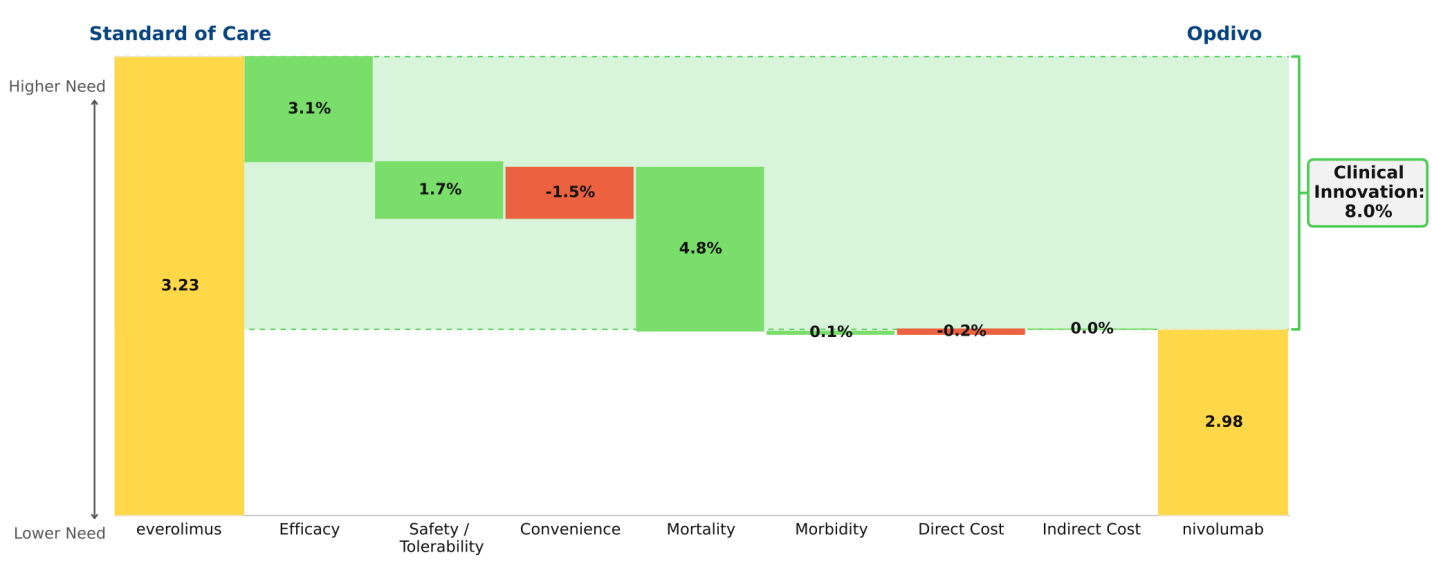
Opdivo has a label for previously treated advanced squamous NSCLC where the standard of care (SOC) has been docetaxel.  Opdivo has superior efficacy compared to docetaxel in all measures: median overall survival, median progression-free survival, overall response rate, as well as a better side effect profile.  Docetaxel’s generic pricing is approximately $3,000 for a 2nd line NSCLC course of therapy, whereas Opdivo has a branded price of approximately $46,000 for a course of therapy in the same indication. Based on historical comparison, Equinox Group concludes that Opdivo’s clinical performance in this population is worth the price premium.  Opdivo will replace docetaxel as the SOC, and should achieve good patient share in NSCLC.

opdivo 1.png

Opdivo in malignant melanoma:

Opdivo was approved as both a monotherapy in later-line melanoma and in combination with Yervoy (ipilimumab) in 1st line melanoma.  In the 1st line setting, the Opdivo + Yervoy combination has a strong 14.6% Clinical Innovation score (or percent reduction in unmet medical need), over the combination of Mekinist (trametinib) + Tafinlar (dabrafenib); it offers better efficacy, side effects, mortality, and morbidity.  While the Opdivo + Yervoy combination has a disadvantage in dosing and higher drug costs, the superior efficacy of the antibodies is decisive.  We therefore expect the Yervoy + Opdivo combination to become the new SOC.  Complete data on a Zelboraf (vemurafenib) and cobimetanib combination in 1st line melanoma will be reported soon.  When that data becomes publicly available we will update this analysis and post our findings here.

Opdivo in 2nd line renal cell carcinoma (RCC):

Opdivo has not yet been approved in 2nd line RCC, but we anticipate its approval based on its superior efficacy over the current SOC.  Opdivo also has a better side effect profile than Afinitor (everolimus), with its only disadvantages being a less convenient dosing regimen and a slightly higher price.  Upon launch, we predict that Opdivo will become the new SOC, and will achieve strong patient share in this population, given its 8.0% Clinical Innovation score.

Avastin: One molecule in multiple cancers

Overview: Avastin (bevacizumab) was the first anti-angiogenesis oncology drug. When it launched in 2004, it was thought that Avastin had virtually limitless potential to be highly effective in a wide range of cancers.  More than a decade later, we know that Avastin competed well in some indications, but not others.  The level of Clinical Innovation Avastin offers in each of these populations correlates well with the level of commercial success the agent has achieved respectively across indications.

Note: Bubble size reflects size of the patient population

Note: Bubble size reflects size of the patient population

The graphic above compares Avastin in multiple oncology indications for three criteria – level of Clinical Innovation, size of the patient population, and level of unmet medical need.  The X axis shows the level of Clinical Innovation Avastin offers in each population; indications right of 0% have positive Clinical Innovation, and those on the left of 0% have negative Clinical Innovation. For instance, Avastin has strong Clinical Innovation (9.2%) in 1st line colorectal cancer. At the other extreme, in 1st line pancreatic cancer, its Clinical Innovation is negative; Avastin never received a label in this population.


The size of the bubble reflects the size of that patient population, and the Y axis reflects the level of medical need (most of these cancer indications have relatively high medical need). Mechanisms with potential in multiple patient segments, such as PD-1 inhibitors, can be assessed in similar ways, given hypotheses for the clinical characteristics of the drug in each of the target populations.  This is useful information to inform the prioritization of indications for development. Below we provide more detail comparing Avastin in two of its labeled indications.

Avastin in colorectal cancer:

In 2004, Avastin was approved in 1st line colorectal cancer as an add-on to the standard of care (SOC) FOLFOX6.

avastin 1.png

There is a strong efficacy advantage in combining Avastin with FOLFOX6 in this population. The improvement in median overall survival (mOS) results in mortality gains; these benefits more than offset the increased cost of adding Avastin to the regimen.  The Avastin combination regimen has Clinical Innovation of 9.2% which is good and should therefore become the SOC, which is exactly what occurred.  


Avastin in non-small cell lung cancer (NSCLC):

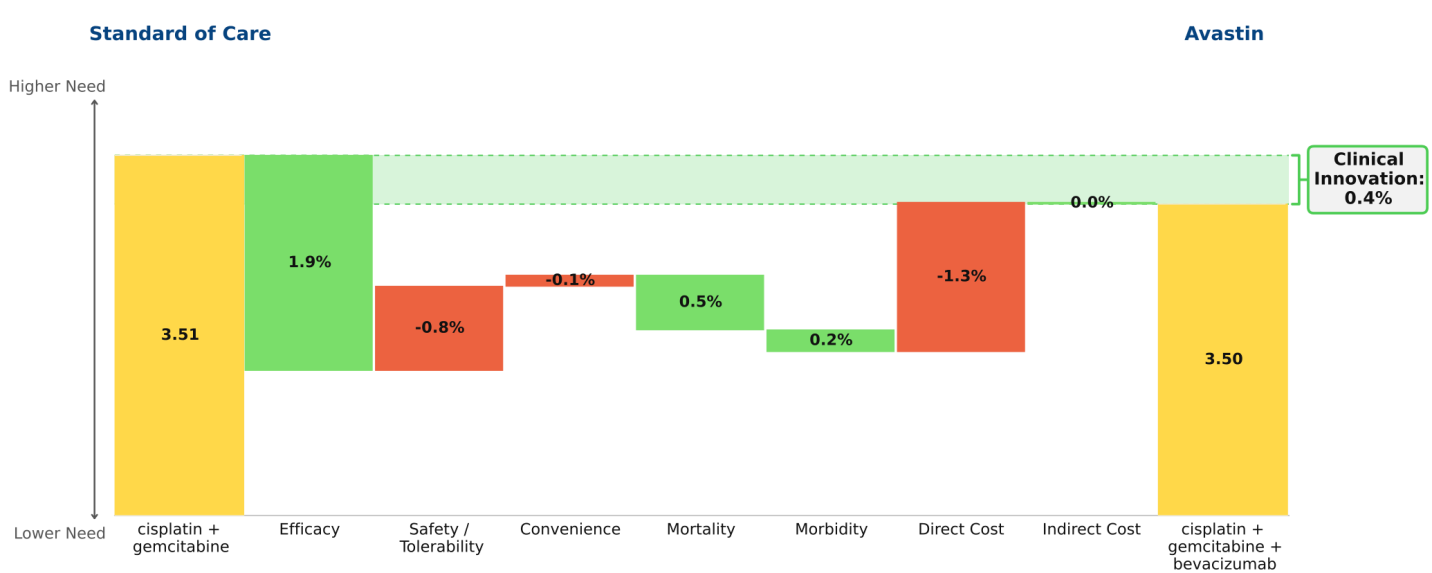
Avastin was approved in 1st line NSCLC in 2006, based on a trial in which it was added to a paclitaxel + carboplatin regimen.  However, our analytical framework shows that the paclitaxel+ carboplatin regimen is inferior to a cisplatin + gemcitabine regiment, and therefore this latter regimen should be considered the SOC.  When we analyze the trial data of gemcitabine + cisplatin with and without Avastin, the Clinical Innovation for the Avastin combination is only 0.4% (“undifferentiated” by our rule of thumb); the efficacy gains are insufficient to offset the increased side effects and drug costs associated with adding Avastin to the gemcitabine combination regimen.  This finding explains why Avastin has had low market penetration in this population. 

avastin 2.png

Jardiance: New outcomes data in type 2 diabetes

Conclusion: Jardiance (empagliflozin) gets a Clinical Innovation score of 5.2% in type 2 diabetes patients with comorbid cardiovascular disease (CVD), based on data from the EMPA‑REG OUTCOME trial reported in September 2015. A 5.2% Clinical Innovation score suggests a “Good” ability to compete for patient share — far better than any other new oral agent launched in type 2 diabetes in many years.

To gain insight into the clinical and commercial meaning of new trial data reported for Jardiance in type 2 patients, we analyzed it in our unmet medical need model, which provides a quantitative measure of clinical improvement over the standard of care (SOC). These new data represent a notable improvement in the Clinical Innovation score for Jardiance in the tested population (those with CVD, who constitute 37% of all type 2 diabetics).

The most significant finding from the study is the relative reduction in all-cause mortality — 32% lower than in the control group (SOC plus placebo). That mortality benefit is the primary driver of Jardiance’s overall Clinical Innovation score, as reflected in our “Drivers of Improvement” chart (below). Unmet medical need in diabetics with CVD is relatively high; on our 0–5 scoring system it comes in at 3.16 for the standard of care (sitagliptan plus metformin). Adding Jardiance to this combination (and many other current combination regimens) reduces medical need by a notable 5.2%, to 2.99 (right side of the chart). Green bars show Jardiance’s advantages, red bars its disadvantages.

jardiance.jpg

The efficacy improvement shown in the “Drivers” graphic above reflects the 14% reduction in cardiovascular events that were seen in the Jardiance-treated patients. The disadvantages of the Jardiance combination regimen — the additional side effects, dosing of an additional pill, and higher drug costs — are small in relation to its advantages in mortality, efficacy, and morbidity.

There have been many new drugs launched for type 2 diabetes in recent years, and despite the proliferation of novel mechanisms, all of them have low Clinical Innovation (close to 0%) and are therefore “undifferentiated”. Jardiance (in the CVD subpopulation) is the first to show Clinical Innovation above the 5% level.

We also analyzed Jardiance in the broader type 2 population, assuming relative reductions in mortality and hospitalizations as reflected in the study’s population. Those assumptions yield a Clinical Innovation score of 2% for Jardiance in the broader population.

Using our share prediction algorithm, we project that Jardiance will reach peak U.S. sales of $2.6 billion at its current price and an additional $1.5 to $2 billion outside the U.S. Most of those sales will come from the comorbid CVD population.

Kyprolis: A rapid rise in a crowded market

Kyprolis (carfilzomib) was granted accelerated FDA approval in July 2012 for the treatment of multiple myeloma. Its recently completed Phase III ASPIRE trial shows even better efficacy. Based on these newly reported clinical data, Kyprolis is highly innovative, as measured in Equinox Group’s framework, and we expect robust sales growth in the future.

The Drivers of Improvement chart shows a strong efficacy advantage in adding Kyprolis to lenalidomide + dexamethasone. The improvements in median overall survival, median progression-free survival, and overall response rate, along with the associated mortality and morbidity gains, more than offset the disadvantages of adding an intravenous therapy to an oral regimen, the increased side effects, and the additional costs. The Clinical Innovation of 14.5% indicates that Kyprolis in combination with lenalidomide + dexamethasone will become the standard of care for patients with multiple myeloma who have been treated with 1-3 prior therapies.

Brintellix: Another "me too" in major depression

Conclusion: Brintellix has “negative Clinical Innovation” relative to generic escitalopram, suggesting that Brintellix will struggle in major depressive disorders, and that sales are unlikely to reach the level predicted by the developers.

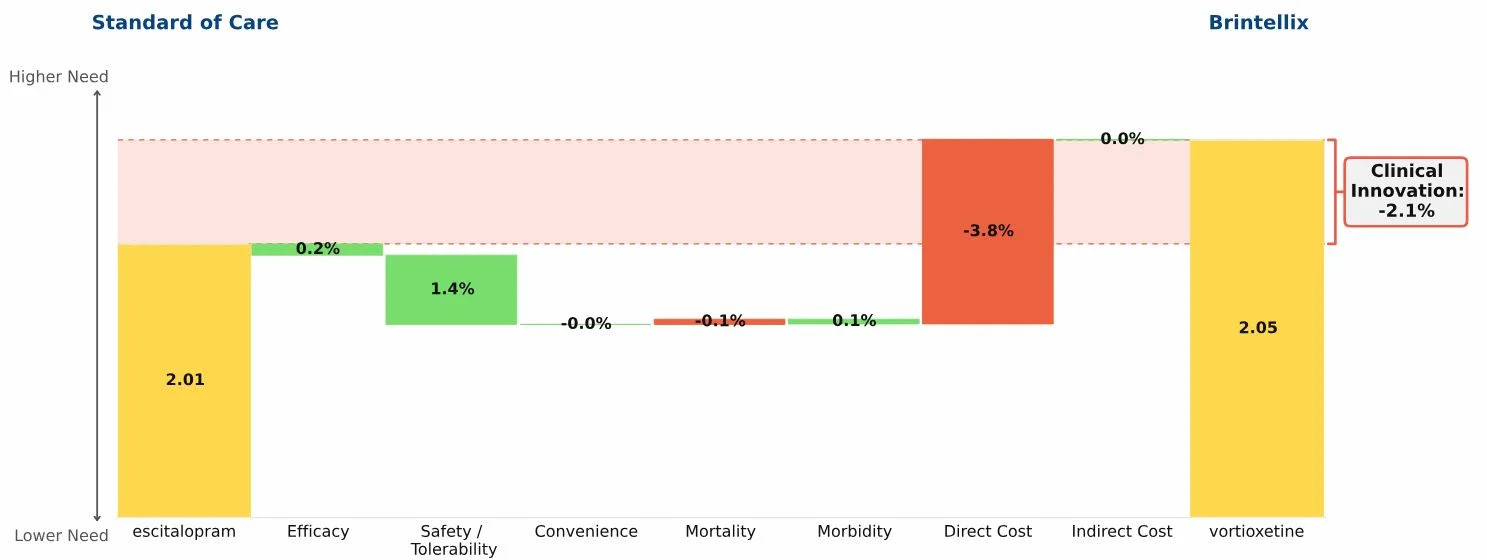
In September 2013 the FDA approved Brintellix (vortioxetine), a new antidepressant from Lundbeck and Takeda. Marketing authorization from the European Medicines Agency was granted in December 2013. The “Drivers of Improvement” waterfall graphic below summarizes the results of our analysis of Brintellix compared to generic escitalopram (the current standard of care):

  • Generic escitalopram’s total unmet medical need score in MDD is 2.01, shown in the yellow bar on the left side of the graphic

  • Brintellix’s unmet need score is 2.05

  • Brintellix’s Clinical Innovation, or percent reduction in medical need, is negative 2.1%, meaning it is at a net competitive disadvantage relative to generic escitalopram

The graphic shows the magnitude of the advantages and disadvantages of Brintellix compared to the escitalopram:

  • The combination of advantages in efficacy and safety/tolerability are modest (summing to 1.6%)

  • Those small advantages are overwhelmed by the negative impact of a much higher branded price for Brintellix compared to generic escitalopram, which gives Brintellix a 3.8% disadvantage in direct cost.

For some patients, the clinical differences may be significant, but we think payers will enforce restricted access to Brintellix, owing to its high price and relatively modest clinical benefits.

Fierce Biotech reported on January 6, 2014, that Lundbeck and Takeda estimate peak-year revenue for Brintellix of $2 billion, and Deutsche Bank has estimated peak sales at $1.85 billion. We at Equinox Group think these estimates are too high. By our established metrics, Brintellix is not clinically innovative – we think it will be perceived as a “me-too” product. The Equinox Share Predictor (which reflects the historical relationship between the Clinical Innovation offered by new drugs and the patient shares they achieve) estimates a patient share that would translate into peak revenue of about $1 billion.

The range of uncertainty in predicting patient shares is wide when Clinical Innovation is close to zero as in this instance. Factors such as promotional spend have a greater effect when there is little clinical differentiation. But in 2007 Pristiq launched in MDD with a 0%Clinical Innovations core against branded escitalopram, and it achieved peak year sales of about $650 million, providing further support for the view that Brintellix is unlikely to achieve $2 billion in peak-year sales.

Pradaxa: Stroke prevention in atrial fibrillation

Our analysis shows Pradaxa (dabigatran) to have high Clinical Innovation over warfarin as the previous SOC for preventing stroke in patients with atrial fibrillation (AF). The “Drivers of Improvement” graphic below summarizes the results of our analysis:

  • Warfarin’s total unmet need score in AF is 1.23, the yellow bar on the left side of the graphic

  • Dabigatran’s unmet need score is 1.04, the yellow bar on the right side of the graphic

  • Dabigatran’s Clinical Innovation, or percent reduction in medical need, is 15.9%: Patients treated with dabigatran have substantially lower unmet need than patients treated with warfarin

This graphic also illustrates dabigatran’s advantages and disadvantages compared with the SOC:

  • An overwhelming efficacy advantage (fewer patients experiencing stroke/systemic embolism)

  • A small advantage in safety/side effects (less monitoring required and fewer drug-drug interactions)

  • A slight disadvantage in dosing (BID vs. QD)

Dabigatran’s higher cost diminishes its innovation score, but its net Clinical Innovation of nearly 16% is still high compared with historical norms. As our model predicts, dabigatran has performed well in the AF market since its launch in late 2010.

Following dabigatran’s launch, several other competitors entered the AF market. Rivaroxiban (Xarelto) was approved for this indication about a year after dabigatran, with similar Clinical Innovation relative to warfarin (with somewhat different strengths and weaknesses to those of dabigatran). Rivaroxiban has also competed effectively in this population. In early 2013, apixaban (Eliquis) was also approved, and again it has a similar level of Clinical Innovation compared with warfarin.

All three of these drugs offer substantial improvement over warfarin, and we expect that they will, collectively, dominate this market. However, we do not expect apixaban to achieve as high a patient share, due to its later market entry. For instance, if dabigatran is considered as the new SOC, then apixaban has minimal Clinical Innovation.

Stelara: Exceeding expectations in psoriasis

Conclusion: The magnitude of Stelara’s advantages (especially in safety/tolerability) explain why it vastly exceeded Wall Street’s sales expectations.

When Stelara (ustekinumab) was launched in 2009 for psoriasis, Wall Street analysts forecasted 2013 revenues of $500 million. However, by 2012, sales of the drug exceeded $1 billion. Our Clinical Innovation analysis shows ustekinumab to have a significant safety/tolerability advantage over TNF-alpha inhibitors such as Humira (adalimumab), which was considered to be the standard of care (SOC) for moderate-to-severe psoriasis when ustekinumab was launched.

The “Drivers of Improvement” graphic below illustrates the comparison:

Adalimumab has an unmet need score in moderate-to-severe psoriasis of 1.73, represented by the yellow bar on the left side of the graphic

  • Ustekinumab’s unmet need score in this population is 1.61, the yellow bar on the right side

  • Ustekinumab’s Clinical Innovation, or percent reduction in medical need, is 6.6%: Patients treated with ustekinumab have lower unmet need than patients treated with adalimumab

Historically, drugs with 5% or greater Clinical Innovation typically achieve strong patient share.

This graphic also illustrates ustekinumab’s advantages and disadvantages compared with the SOC:

  • The two drugs have comparable efficacy, with ustekinumab showing a slight advantage over adalimumab

  • Based on currently available data, ustekinumab has an improved safety/tolerability profile over adalimumab, with no black box warning and lower rates of infection

  • Ustekinumab is administered as an SC injection once every three months, compared to adalimumab’s twice weekly injections; however, the requirement that ustekinumab be administered in the outpatient setting offsets its frequency advantage

  • Ustekinumab’s annual drug cost is slightly higher than adalimumab’s

Our analysis shows that ustekinumab offers significant Clinical Innovation over adalimumab, and its commercial performance to date supports this conclusion.

Outlook for IL-17 receptor antagonists

A new class of drugs may soon enter the competitive landscape in moderate-to-severe psoriasis. Amgen, Eli Lilly, and Novartis all have IL-17 receptor antagonists in phaseIIItrials for this indication. Amgen’s product brodalumab has shown the strongest phase II data among the three. Based on these data and assuming price equivalence with ustekinumab, our analysis shows brodalumab to offer a strong 7.3% Clinical Innovation.

While brodalumab and ustekinumab show a similar percentage of patients responding (90% and 91%, respectively achieving at least a 50% PASI improvement at 12 weeks), almost twice as may brodalumab patients as ustekinumab patients (74% vs. 38%) reach at least 90% PASI improvement. Also, significantly more brodalumab patients have a physician’s global assessment (PGA) of disease as “cleared” or “minimal” (83% vs. 65%). Absent long-term data, we conservatively assume that the percentage of patients maintaining cleared or minimal PGA response at two years will be the same as that seen with ustekinumab.

Our analysis shows brodalumab to have a slight safety/tolerability disadvantage compared with ustekinumab; we assume it will have a black box warning due to a rate of severe bacterial infections comparable to adalimumab’s.

Brodalumab dosing is by SC injection every other week, which our framework considers slightly less convenient than an outpatient injection once every three months.

In our view, the Clinical Innovation of brodalumab over ustekinumab is similar to that shown by ustekinumab over adalimumab. If phase III trials of brodalumab replicate the efficacy and safety/tolerability data seen in phase II, we predict that brodalumab will achieve substantial patient share in the moderate-to-severe psoriasis market.