
Keytruda: Exceptional early results in a small colorectal cancer population
Conclusion: Keytruda (pembrolizumab) is highly efficacious in a subset of colorectal cancer patients that are heavily pretreated, have metastatic disease, and have mismatch repair deficiency. Despite a very high price for a course of therapy, the clinical results overwhelmingly favor pembrolizumab’s use over best supportive care in this subpopulation.
Results were recently published of Keytruda (pembrolizumab) in metastatic colorectal cancer patients who had been treated with a median of four prior therapies. In such a sick and heavily pretreated patient population, it would not be expected that any therapy would make a significant difference, and for most colorectal cancer patients that is the case. However, for a low single-digit percentage of them who are mismatch repair-deficient, pembrolizumab is highly effective. Limited Phase II data show a clinically significant overall response rate, along with exceptionally promising trends in progression-free survival and overall survival. Despite a steep $350,000 pre-discount price for a 20-week course of therapy, the percent reduction in unmet medical need is a highly innovative 35%.
We project that Keytruda will extend median overall survival by 1 to 2 years as opposed to the handful of months to be expected with best supportive care. Survival data in the mismatch repair-proficient population were not nearly as impressive, with clinical performance probably not sufficient to offset the price. We expect pembrolizumab will achieve a label in mismatch repair-deficient colorectal cancer, and will become the standard of care. Furthermore, we expect pembrolizumab will eventually be used in earlier lines of therapy, and testing for mismatch repair deficiency will become far more common.

Blincyto: High price for an undifferentiated drug
Conclusion: Amgen’s Blincyto (blinatumomab) shows minimal efficacy and tolerability gains over older multi-drug induction regimens, yet it is priced at around $200,000 for a full course of treatment. If the company succeeds in expanding the drug’s label, it is likely to face pressure to lower the price significantly unless it can show considerably more clinical improvement in those expanded patient populations.
In December 2014, the FDA approved Blincyto (blinatumomab) for 2nd line treatment of a rare form of acute lymphoblastic leukemia (ALL). The addressable patient population is so small that Blincyto usually wouldn’t have drawn much attention, but it has been in the headlines due to its steep price. The drug is priced in line with other ultra-orphan drugs. But Blincyto doesn’t deliver the step-change in efficacy that other six-figure drugs have brought to the table. Before Blincyto’s approval, induction was carried out using various multi-drug regimens. Some are better than others, but none had become a universal therapeutic choice.

Blincyto does have an efficacy advantage over all of the multi-drug regimens, but it is incremental in most cases. Blincyto also has a slight side effect advantage, and it is likely more convenient for the infusion centers to dose (patients might not notice much of a difference). For all these advantages, Blincyto’s improvement in Clinical Innovation, or percent reduction in unmet medical need, is more than offset by its huge price, which is roughly an order of magnitude more than that of the multi-drug regimens. Blincyto is currently being trialed in larger ALL patient populations, as well as the largest subset of non-Hodgkin’s lymphoma patients. We expect there will be much more pressure on the drug price if Blincyto is able to gain a label in a larger patient population.
PD-1 Inhibitors: Strong starts in three indications
PD-1 inhibitors are the newest class of immunotherapy drugs approved for cancer. They have a unique mechanism of action and debuted in the market for melanoma amid great promise. Like Avastin (bevacizumab) before them, PD-1 inhibitors have labels in multiple cancers and are in late-stage trials in many more. The data for Keytruda (pembrolizumab) and Opdivo (nivolumab) in both melanoma and non-small cell lung cancer (NSCLC) clearly demonstrate that PD-1 inhibitors represent a major advance in cancer therapy. Equinox Group will monitor this area and update our analyses as more clinical data becomes available. Below we focus on Opdivo in several tumor types.
Opdivo in non-small cell lung cancer (NSCLC):
Opdivo has a label for previously treated advanced squamous NSCLC where the standard of care (SOC) has been docetaxel. Opdivo has superior efficacy compared to docetaxel in all measures: median overall survival, median progression-free survival, overall response rate, as well as a better side effect profile. Docetaxel’s generic pricing is approximately $3,000 for a 2nd line NSCLC course of therapy, whereas Opdivo has a branded price of approximately $46,000 for a course of therapy in the same indication. Based on historical comparison, Equinox Group concludes that Opdivo’s clinical performance in this population is worth the price premium. Opdivo will replace docetaxel as the SOC, and should achieve good patient share in NSCLC.

Opdivo in malignant melanoma:
Opdivo was approved as both a monotherapy in later-line melanoma and in combination with Yervoy (ipilimumab) in 1st line melanoma. In the 1st line setting, the Opdivo + Yervoy combination has a strong 14.6% Clinical Innovation score (or percent reduction in unmet medical need), over the combination of Mekinist (trametinib) + Tafinlar (dabrafenib); it offers better efficacy, side effects, mortality, and morbidity. While the Opdivo + Yervoy combination has a disadvantage in dosing and higher drug costs, the superior efficacy of the antibodies is decisive. We therefore expect the Yervoy + Opdivo combination to become the new SOC. Complete data on a Zelboraf (vemurafenib) and cobimetanib combination in 1st line melanoma will be reported soon. When that data becomes publicly available we will update this analysis and post our findings here.
Opdivo in 2nd line renal cell carcinoma (RCC):
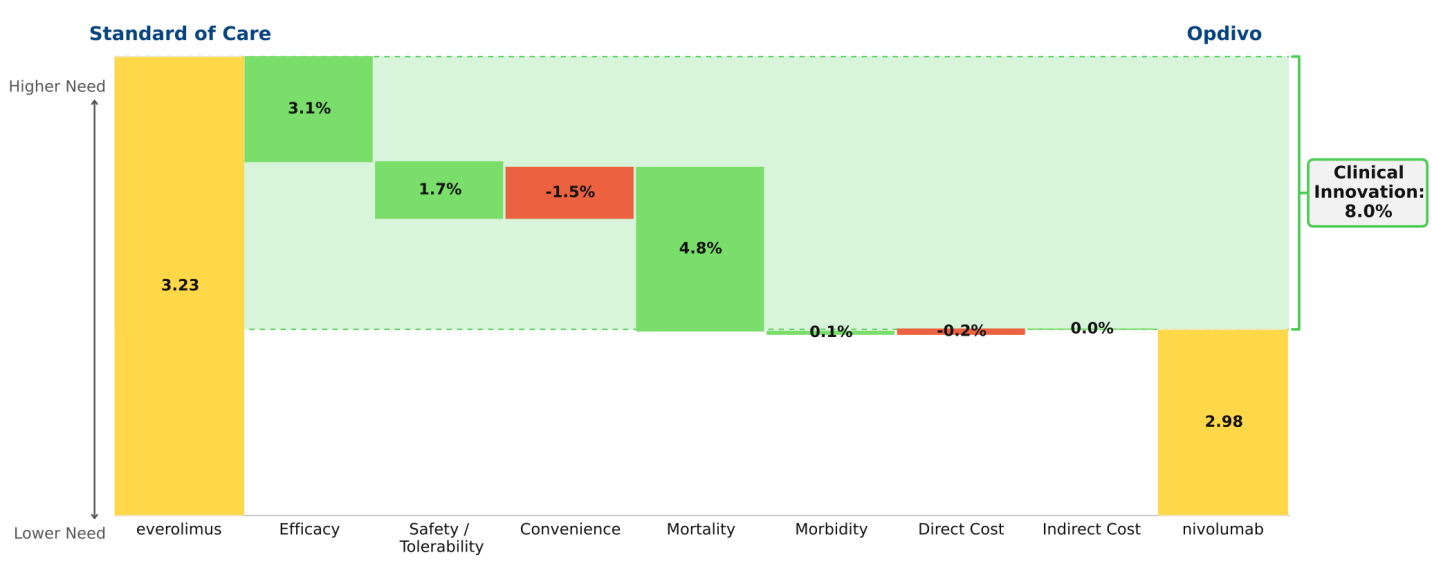
Opdivo has not yet been approved in 2nd line RCC, but we anticipate its approval based on its superior efficacy over the current SOC. Opdivo also has a better side effect profile than Afinitor (everolimus), with its only disadvantages being a less convenient dosing regimen and a slightly higher price. Upon launch, we predict that Opdivo will become the new SOC, and will achieve strong patient share in this population, given its 8.0% Clinical Innovation score.
Avastin: One molecule in multiple cancers
Overview: Avastin (bevacizumab) was the first anti-angiogenesis oncology drug. When it launched in 2004, it was thought that Avastin had virtually limitless potential to be highly effective in a wide range of cancers. More than a decade later, we know that Avastin competed well in some indications, but not others. The level of Clinical Innovation Avastin offers in each of these populations correlates well with the level of commercial success the agent has achieved respectively across indications.

Note: Bubble size reflects size of the patient population
The graphic above compares Avastin in multiple oncology indications for three criteria – level of Clinical Innovation, size of the patient population, and level of unmet medical need. The X axis shows the level of Clinical Innovation Avastin offers in each population; indications right of 0% have positive Clinical Innovation, and those on the left of 0% have negative Clinical Innovation. For instance, Avastin has strong Clinical Innovation (9.2%) in 1st line colorectal cancer. At the other extreme, in 1st line pancreatic cancer, its Clinical Innovation is negative; Avastin never received a label in this population.
The size of the bubble reflects the size of that patient population, and the Y axis reflects the level of medical need (most of these cancer indications have relatively high medical need). Mechanisms with potential in multiple patient segments, such as PD-1 inhibitors, can be assessed in similar ways, given hypotheses for the clinical characteristics of the drug in each of the target populations. This is useful information to inform the prioritization of indications for development. Below we provide more detail comparing Avastin in two of its labeled indications.
Avastin in colorectal cancer:
In 2004, Avastin was approved in 1st line colorectal cancer as an add-on to the standard of care (SOC) FOLFOX6.

There is a strong efficacy advantage in combining Avastin with FOLFOX6 in this population. The improvement in median overall survival (mOS) results in mortality gains; these benefits more than offset the increased cost of adding Avastin to the regimen. The Avastin combination regimen has Clinical Innovation of 9.2% which is good and should therefore become the SOC, which is exactly what occurred.
Avastin in non-small cell lung cancer (NSCLC):
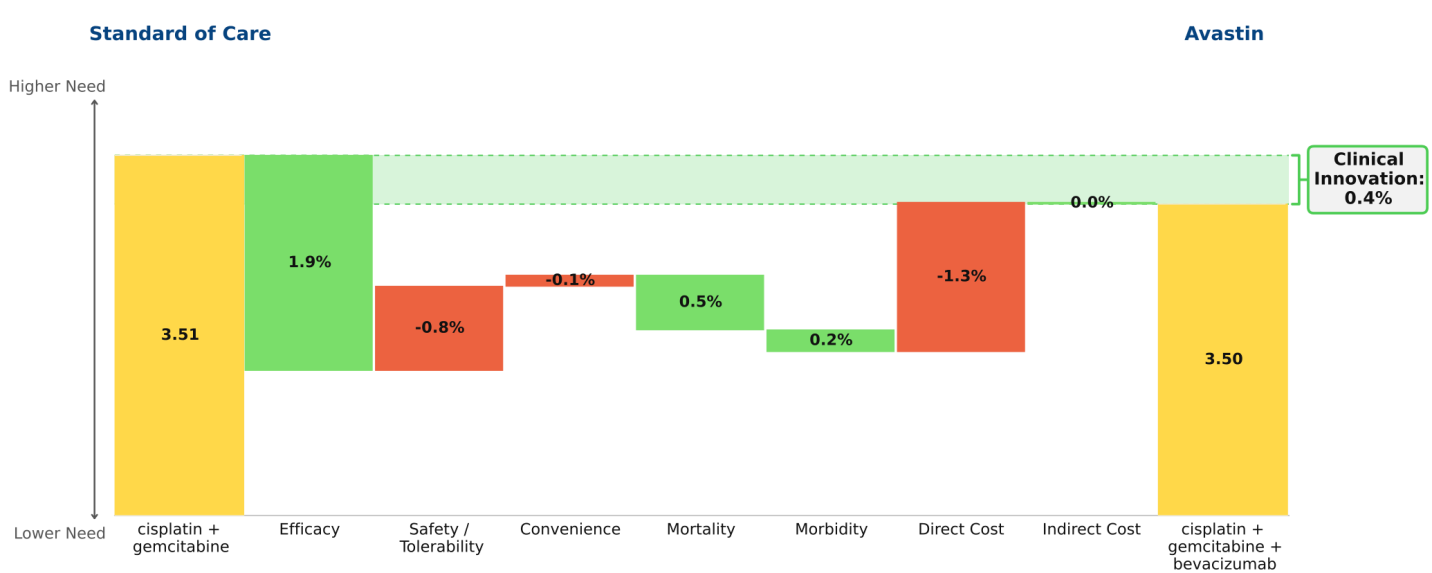
Avastin was approved in 1st line NSCLC in 2006, based on a trial in which it was added to a paclitaxel + carboplatin regimen. However, our analytical framework shows that the paclitaxel+ carboplatin regimen is inferior to a cisplatin + gemcitabine regiment, and therefore this latter regimen should be considered the SOC. When we analyze the trial data of gemcitabine + cisplatin with and without Avastin, the Clinical Innovation for the Avastin combination is only 0.4% (“undifferentiated” by our rule of thumb); the efficacy gains are insufficient to offset the increased side effects and drug costs associated with adding Avastin to the gemcitabine combination regimen. This finding explains why Avastin has had low market penetration in this population.
Kyprolis: A rapid rise in a crowded market
Kyprolis (carfilzomib) was granted accelerated FDA approval in July 2012 for the treatment of multiple myeloma. Its recently completed Phase III ASPIRE trial shows even better efficacy. Based on these newly reported clinical data, Kyprolis is highly innovative, as measured in Equinox Group’s framework, and we expect robust sales growth in the future.

The Drivers of Improvement chart shows a strong efficacy advantage in adding Kyprolis to lenalidomide + dexamethasone. The improvements in median overall survival, median progression-free survival, and overall response rate, along with the associated mortality and morbidity gains, more than offset the disadvantages of adding an intravenous therapy to an oral regimen, the increased side effects, and the additional costs. The Clinical Innovation of 14.5% indicates that Kyprolis in combination with lenalidomide + dexamethasone will become the standard of care for patients with multiple myeloma who have been treated with 1-3 prior therapies.