
Finding the Right Price for a Drug across Multiple Indications; Learnings from Keytruda
Previously, Equinox has described a hypothetical exercise in which a development team attempts to find an optimal price for an agent that is in development in multiple indications.
Here we repeat this exercise with a real-world example, Keytruda.
Keytruda has been approved for a variety of indications.
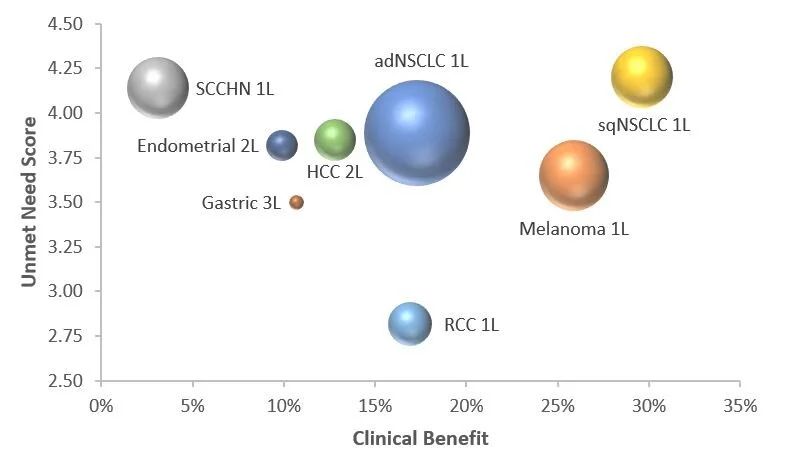
These indications differ in the size of the addressable patient population (bubble size), the level of unmet need (y axis) and, most importantly, the degree to which Keytruda delivers benefit to patients (x axis).
Finding the right price-per-vial across diverse indications is challenging. Equinox’s analytical tools allow product teams to quantify the value delivered in each population. When we plot the incremental clinical benefit delivered against incremental cost for successful agents, we see the following “cloud” relationship:

Each point represents a new agent in a specific patient population.
Equinox predicts that emerging agents that map within this cloud will receive favorable reimbursement, but agents that land below the cloud risk significant push-back from payers in those indications. Points above the cloud represent indications where the agent is under-priced.
Compared to these exemplars, Keytruda’s various indications map as follows:
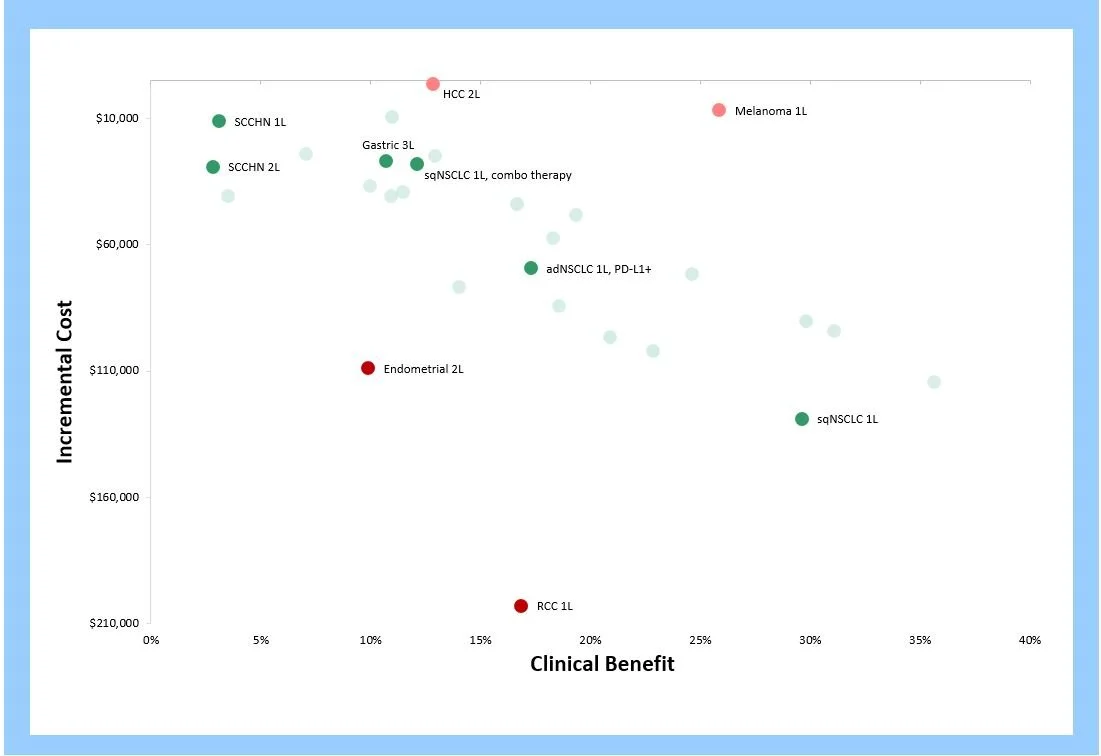
Keytruda’s price appears appropriate for Gastric, Head and Neck, and Lung Cancer. As a consequence, it offers poor value for money in RCC and Endometrial, and leaves money on the table in HCC and Melanoma. Overall, the price point appears optimized.
Equinox’s analytical tools allow product teams to assess the trade-offs inherent in arriving at a price for any agent in development for multiple indications.
Enhertu: A New Leader in Later-Line Breast Cancer
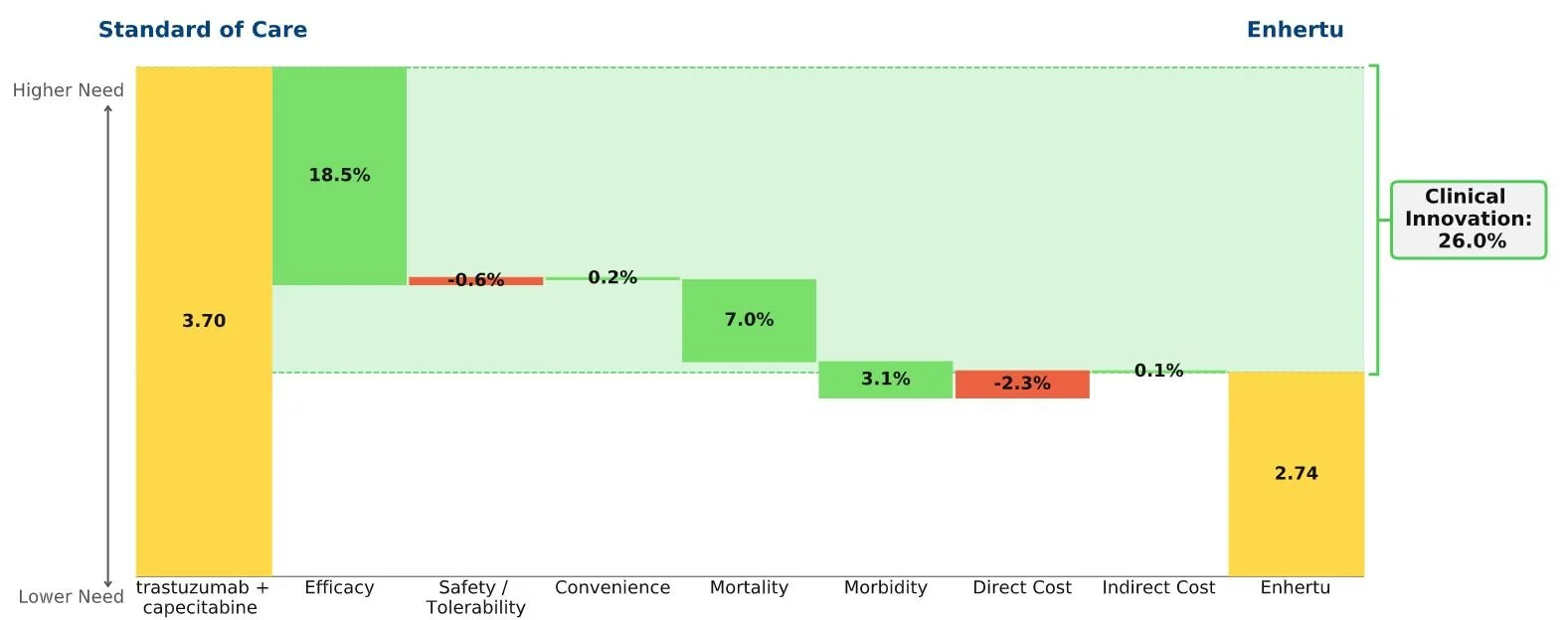
Conclusion: Enhertu achieves an impressive clinical innovation score for its substantial efficacy improvements over the current SOC (trastuzumab + capecitabine) for adults with HER2+ metastatic breast cancer who have failed multiple prior therapies.
Enhertu (trastuzumab deruxtecan, Daiichi-Sankyo and AstraZeneca) was approved in December 2019 for HER2+ unresectable or metastatic breast cancer patients who have received multiple prior anti-HER2 treatments. It boasts a significant increase in progression-free survival compared to the current standard of care (SOC), trastuzumab + capecitabine (16.4 vs. 5.6 months), as well as a notable improvement in overall response rate (60.9% vs. 22.8%). While survival data is not yet mature, even the most conservative of estimates sees Enhertu winning the day for HER2+ patients eligible for a third or later line of treatment.
The waterfall chart below shows that Enhertu’s improvements in efficacy far outweigh its higher cost and slightly worse side effect profile when compared to the current SOC. The jump in efficacy, as well as its trickle-down effect on mortality and morbidity, deliver a strong clinical innovation score of 26%.
We expect Enhertu to dominate treatment in this setting within two years. Analysts’ estimates of peak sales around $2.5 billion are reasonable.
PARP Inhibitors: Promise in New Maintenance Indications
Conclusion: PARP inhibitors Zejula and Lynparza both show significant clinical benefit in new maintenance populations in ovarian and pancreatic cancers, respectively. Fortunately for both assets, their clinical benefit in the new indications supports their current prices.
PARP inhibitors are advancing into more indications after their initial approvals in later-line ovarian and breast cancer. While the cancers that the PARP inhibitors are pursuing differ significantly in unmet need, our analyses suggest that both Zejula and Lynparza are unlikely to encounter market access friction in their latest indications.
Results were recently published for Zejula (niraparib, GlaxoSmithKline) in the maintenance setting for newly diagnosed stage III and IV ovarian cancer patients who respond to platinum-based chemotherapy. Zejula is still awaiting approval in this indication, but there are no maintenance options for most of these patients, leaving a wide window of opportunity. Lynparza (olaparib, AstraZeneca/Merck) is the only PARP inhibitor currently playing in first-line ovarian maintenance, and only for the 15% of patients who have a BRCA mutation. Should Zejula receive its sought-after label expansion, its new maintenance data includes results for both BRCA-positives and “all comers”. Zejula is already approved in both ovarian cancer patients with refractory disease who have homologous recombination deficiencies (HRDs) and in second-line maintenance.
Fortunately for GSK, adding Zejula as maintenance therapy for first-line ovarian cancer patients (regardless of BRCA mutation) offers a tremendous clinical benefit of 39% in our framework, largely driven by improvements in both efficacy and mortality. The benefit is even greater in HRD patients, in whom Zejula provides a 56% clinical benefit.

Like Zejula, AstraZeneca/Merck’s PARP inhibitor, Lynparza, recently sought out and received approval as maintenance therapy in pancreatic cancer patients with a BRCA mutation. This is Lynparza’s fifth approval and the first approved therapy for maintenance following first-line therapy in pancreatic cancer. While BRCA-mutated pancreatic cancer has a smaller overall population than Lynparza’s other indications (ovarian and breast cancer), the low level of competition makes for an attractive opportunity, especially among BRCA-mutated patients.
Lynparza offers a significant clinical benefit of 16.6% as maintenance in BRCA-mutated pancreatic cancer. While it didn’t show a significant survival benefit, Lynparza nearly doubled time to progression from 3.8 months to 7.4 months in a recent phase 3 trial.

Using our Cost vs. Benefit tool, we can plot both Zejula and Lynparza in their respective indications within a historical data set of new oncology drugs that achieved favorable market access. Incremental cost (inverted) is plotted along the y-axis and clinical benefit along the x-axis, showing a clear relationship between clinical benefit in successful therapies and cost. We believe that drugs that fall within the resulting cloud are priced appropriately given their clinical benefit.
While Zejula and Lynparza are priced slightly higher than other agents offering similar levels of clinical benefit, they are within range of historical analogs. We consider them appropriately priced in these indications and expect them to receive favorable market access.
U.S. WAC prices are $372/day for Zejula and $472/day for Lynparza.

While our analysis predicts strong market access for Zejula, the competition for this indication is likely to be fierce. Avastin/Lynparza dual therapy and veliparib monotherapy have both recently released positive results in maintenance clinical trials. Though capturing the market will be no easy feat for GSK, Equinox Group believes Zejula is well positioned to become the market leader. This is largely due to the fact that the PRIMA trial (Zejula maintenance vs placebo) included patients who responded to any chemotherapy regimen, while the trials for Avastin/Lynparza and veliparib maintenance only included patients who received induction with, respectively, Avastin-containing and veliparib-containing regimens, limiting the potential patient populations they can tap into.
Contrastingly, Lynparza faces only one potential competitor, Rubraca (rucaparib, Clovis Oncology). Given the low level of competition and the clinical benefit that Lynparza offers compared to its price, we believe that Lynparza will also achieve considerable market share.
Our analysis incorporated data from the PRIMA, VELIA, PAOLA-1 and POLO trials, as well as prescribing information for Zejula and Lynparza.
Candidate Observations to Be Added to Equinox’s Oncology Normative Pricing Model
Equinox Group has recently analyzed six more observations that are candidates for inclusion in our oncology normative pricing model. The graphic below shows the new observations (green dots) as a holdout set compared to the original observations (blue dots). The benefit vs. cost (price) ratios for the new set closely match those in the original set and should provide an even more robust basis for predicting pricing potential for new agents once incorporated into the next generation of the model in early 2020.
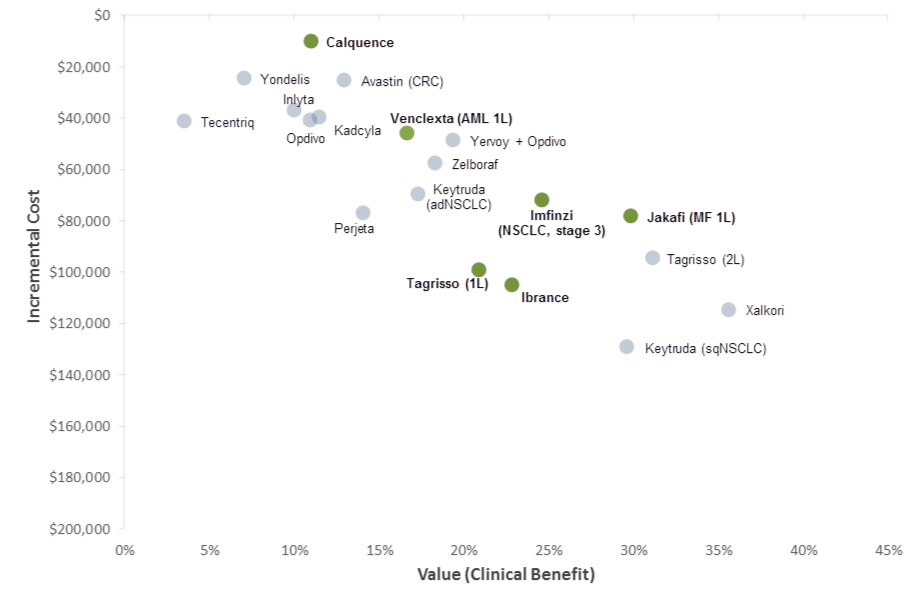
Pale dots: original observation set
Green dots: new candidate observations
Background: Equinox Group’s oncology normative pricing model allows drug development teams to estimate the pricing potential of their developmental programs as a function of their anticipated clinical attributes. The model is based on analysis of clinical improvement vs. cost (price) for a set of oncology agents that have achieved favorable market access in recent years. That analysis shows that there is a clear and quantifiable relationship between clinical benefit and cost among successful drugs. Development teams can easily explore how alternative clinical outcomes for an agent will affect its pricing potential in each of its target indications.
Tecentriq and Imfinzi Both Offer Modest Improvements in SCLC
Conclusion: The clinical improvement of Tecentriq (atezolizumab, Roche) in untreated extensive-stage small cell lung cancer is positive, but modest. New data recently announced for Imfinzi (durvalumab, AstraZeneca) looks about the same. The impact on incremental cost in this population (driven by the drugs’ prices), however, are not far outside recent historical norms, which suggests both regimens will be reimbursed by payers.

Roche’s Tecentriq won FDA approval in March 2019 as the only immuno-oncology therapy for previously untreated extensive-stage small cell lung cancer. AstraZeneca plans on introducing competition soon; in September 2019 the company reported positive results from their Imfinzi study. Each drug was trialed as an add-on to carboplatin plus etopiside. Imfinzi reported slightly higher median overall survival than Tecentriq showed (13.0 vs. 12.3 months). Unsurprisingly, its overall improvement as measured in Equinox Group’s analytical model is about the same as Tecentriq’s.
Although not negligible, Tecentriq’s and Imfinzi’s clinical innovation scores of 4.7% (shown above) and 5.4%, respectively, leave significant room for improvement in a population with high unmet medical need that includes 11% of all lung cancer patients. These clinical innovation scores are well below those recently achieved in other lung cancer populations, e.g., Keytruda in adNSCLC and sqNSCLC, and Tagrisso in EGFR+ Lung cancer (shown below).
Plotting clinical benefit against cost, the figure below confirms that both drugs offer modest innovation compared to other recent launches, but the incremental cost (prices) for both regimens are not high relative to recent historical norms for new oncology agents that have achieved favorable market access.

Our analysis incorporated data from the CASPIAN and IMpower133 clinical trials and the full prescribing information for Tecentriq and Imfinzi.
Calquence: The price is right
Conclusion: Our Cost vs. Benefit analysis indicates that Calquence is appropriately priced.
Calquence offers moderate clinical benefit compared to Imbruvica, the standard of care in relapsed/refractory mantle cell lymphoma. Calquence delivers a solid efficacy improvement, the effects of which flow through to improved mortality and morbidity. Combine these factors with somewhat favorable side effects and only slightly worse convenience and Calquence makes for a solid upgrade from Imbruvica. Calquence charges about $170,000/ year (WAC price) compared to Imbruvica’s $157,000. Given its level of clinical benefit, it is appropriately priced.

Our Cost vs. Benefit tool allows us to plot Calquence within a historical data set of new oncology drugs that have achieved favorable market access. Incremental cost is plotted along the y-axis and clinical benefit along the x-axis. Our historical data set shows a clear relationship between clinical benefit and cost, forming a cloud of data points. In general, drugs that fall within this cloud are priced appropriately given the level of clinical benefit they offer. Calquence lands just barely above the cloud, which means given the level of clinical benefit it provides, it may have been able to warrant a slightly higher price, but is well within the range of historical analogs.
In relapsed/refractory chronic lymphocytic leukemia, Calquence has shown promising 12 month data, but these data are not yet sufficiently mature to allow us to estimate its clinical benefit in that population. We will update our analyses as more mature data becomes available.

How to Price an Oncology Drug
It is widely agreed that drugs should be priced to reflect their value, or clinical benefit. But how does one measure clinical benefit? Equinox Group uses a proven method to quantify clinical benefit, derived from our deep experience in assessing unmet medical need.

A new drug’s proposed cost (on Y-axis, inverted scale) should align with its promised clinical benefit (on X-axis) to place it in the “cloud” of successful recent launches.
Locating clinical benefit on a specific scale allows us to examine how benefit is related to drug price in many recent launches that have gained good market access. Our analysis of drugs that have achieved favorable market access shows a clear relationship between cost and benefit. That observation allows us to advise companies on appropriate pricing for their emerging oncology agents.
Our measure of clinical benefit reflects efficacy, safety/tolerability and dosing, and how efficacy affects disease burden – mortality, morbidity, and cost.
We can model the expected attributes of a new agent against the background of disease burden in a specific patient population to test the clients’ desired price for the asset. We can plot the results on the graph above to determine if the new drug falls within “the cloud” of successful agents. If it does, the drug will most likely achieve favorable market access at the desired price. If not, a rethinking of the pricing strategy may be called for. Our analysis can be applied to the US and each of the five major EU countries, and the same framework can deliver estimates of peak-year patient share and revenue.
Clinical benefit and drug cost vary by patient segment because of duration of treatment, disease seriousness, and a host of other factors, so we analyze each target indication separately. That way, agents with potential in multiple populations can be analyzed in each indication to find the optimizing price for the asset across the board.
Imbruvica: Closing the window of opportunity in CLL
Conclusion: Imbruvica (ibrutinib) delivers profound improvements in efficacy and outcomes in first-line chronic lymphocytic leukemia (CLL); as a result it virtually eliminates the opportunity for developmental agents to offer significant Clinical Innovation in this indication.
The key data supporting the March 2016 label expansion granted to Imbruvica (ibrutinib) for the first-line treatment of chronic lymphocytic leukemia (CLL) are dramatic: 98% progression-free survival at 18 months and 90% survival at 24 months (RESONATE-2 trial). Regardless of the standard of care to which we compare Imbruvica, it represents dramatic innovation, changing a feared malignancy into a mostly manageable chronic disease, much as Gleevec (imatinib) did in chronic myelogenous leukemia (CML) more than a decade ago. The waterfall chart compares Imbruvica to chlorambucil, reflecting RESONATE-2 data.

The implications for companies developing drugs targeted at CLL are profound:
It will be virtually impossible to deliver significant Clinical Innovation beyond what Imbruvica appears to offer; the only remaining significant unmet need targets are safety/tolerability and cost (see schema figure below).
It will become difficult to recruit first-line patients for clinical trials when as attractive a treatment option as Imbruvica is available, and the trial duration needed to show equivalence to Imbruvica begins to look onerous in relation to the opportunity.
At the same time, relapsed/refractory CLL becomes a much less attractive commercial target. By pushing out progression from first line for years, Imbruvica will radically reduce the number of treatable patients available at second and third lines during the next 5-10 years.
With CLL joining CML, hepatitis C viral infection, and multiple myeloma as serious diseases that can now be more or less cured with drugs, price will become a more important factor in product selection. Agents no better clinically than Imbruvica in CLL or Harvoni in HCV will need to accept lower prices, whether directly or through contracting, to capture much market share.
Since Imbruvica has reduced unmet medical need so dramatically, companies with competing drugs targeting CLL in Phase II or earlier must rethink their development strategies, redirecting resources to other cancer targets.

This figure shows the domains of medical need in first line CLL. The gold bars reflect how well ibrutinib satisfies need in each domain. The grey area above the gold bar shows the extent of opportunity for improvement for developmental agents. We derive ibrutinib’s values by transforming clinical data to dimensionless index scores between 0 (no need―e.g., perfect efficacy) and 5 (no satisfaction of need―e.g., no efficacy). The transformation functions are consistent across indications, and domain analyses are built up from detailed sub-analyses.
The interpretation for ibrutinib in CLL is that little opportunity remains for improving efficacy, convenience, mortality, or morbidity. The only remaining opportunity for meaningful improvement is in safety/tolerability. The high level of need in the cost domain is driven by high drug cost (which is warranted, given the magnitude of clinical benefit).
Keytruda: Exceptional early results in a small colorectal cancer population
Conclusion: Keytruda (pembrolizumab) is highly efficacious in a subset of colorectal cancer patients that are heavily pretreated, have metastatic disease, and have mismatch repair deficiency. Despite a very high price for a course of therapy, the clinical results overwhelmingly favor pembrolizumab’s use over best supportive care in this subpopulation.
Results were recently published of Keytruda (pembrolizumab) in metastatic colorectal cancer patients who had been treated with a median of four prior therapies. In such a sick and heavily pretreated patient population, it would not be expected that any therapy would make a significant difference, and for most colorectal cancer patients that is the case. However, for a low single-digit percentage of them who are mismatch repair-deficient, pembrolizumab is highly effective. Limited Phase II data show a clinically significant overall response rate, along with exceptionally promising trends in progression-free survival and overall survival. Despite a steep $350,000 pre-discount price for a 20-week course of therapy, the percent reduction in unmet medical need is a highly innovative 35%.
We project that Keytruda will extend median overall survival by 1 to 2 years as opposed to the handful of months to be expected with best supportive care. Survival data in the mismatch repair-proficient population were not nearly as impressive, with clinical performance probably not sufficient to offset the price. We expect pembrolizumab will achieve a label in mismatch repair-deficient colorectal cancer, and will become the standard of care. Furthermore, we expect pembrolizumab will eventually be used in earlier lines of therapy, and testing for mismatch repair deficiency will become far more common.

Blincyto: High price for an undifferentiated drug
Conclusion: Amgen’s Blincyto (blinatumomab) shows minimal efficacy and tolerability gains over older multi-drug induction regimens, yet it is priced at around $200,000 for a full course of treatment. If the company succeeds in expanding the drug’s label, it is likely to face pressure to lower the price significantly unless it can show considerably more clinical improvement in those expanded patient populations.
In December 2014, the FDA approved Blincyto (blinatumomab) for 2nd line treatment of a rare form of acute lymphoblastic leukemia (ALL). The addressable patient population is so small that Blincyto usually wouldn’t have drawn much attention, but it has been in the headlines due to its steep price. The drug is priced in line with other ultra-orphan drugs. But Blincyto doesn’t deliver the step-change in efficacy that other six-figure drugs have brought to the table. Before Blincyto’s approval, induction was carried out using various multi-drug regimens. Some are better than others, but none had become a universal therapeutic choice.

Blincyto does have an efficacy advantage over all of the multi-drug regimens, but it is incremental in most cases. Blincyto also has a slight side effect advantage, and it is likely more convenient for the infusion centers to dose (patients might not notice much of a difference). For all these advantages, Blincyto’s improvement in Clinical Innovation, or percent reduction in unmet medical need, is more than offset by its huge price, which is roughly an order of magnitude more than that of the multi-drug regimens. Blincyto is currently being trialed in larger ALL patient populations, as well as the largest subset of non-Hodgkin’s lymphoma patients. We expect there will be much more pressure on the drug price if Blincyto is able to gain a label in a larger patient population.