
Zegfrovy (sunvozertinib, Dizal Pharmaceuticals), which received FDA approval as second-line treatment for NSCLC patients with EGFR exon 20 insertion mutations on July 2, 2025 but has not launched in the US, is the latest addition to what has become a suite of lung cancer assets in AstraZeneca’s portfolio. The oncology giant penned a $1.5B exclusive global licensing agreement with Dizal, its former Shanghai-based R&D hub that spun off in 2017.
Unlike AZ’s Tagrisso, which has proven essentially ineffective in this subset of patients, Zegfrovy displayed strong efficacy with a 0.65 HR for progression-free survival and a near doubling in overall response rate when compared with chemotherapy alone in the phase III WU-KONG28 trial. [1,2] Due to a 72% crossover rate in the control arm, 91.3% of which were to Zegfrovy monotherapy, the overall survival benefit was diluted out.
Rybrevant (amivantamab, J&J) plus chemotherapy posted numerically superior results in its pivotal PAPILLON trial, with a 0.4 HR for progression-free survival, a 50% increase in overall response rate, and an insignificant OS benefit due to crossover. However, the impact of crossover was slightly less severe than in the WU-KONG trial as 62.6% of chemotherapy patients crossed over to Rybrevant monotherapy. [3,4]
The patients from the chemotherapy arms in these trials who crossed over to Zegfrovy and Rybrevant monotherapies are estimated to have achieved 0- and 5-month improvements over the chemotherapy group writ large, suggesting that, when only considering monotherapies, Zegfrovy may offer longer survival. A similar conclusion is reached when looking at the progression-free survival data. [2,3]
Unlike Zegfrovy, Rybrevant trialed in combination with chemotherapy at 1L. A rank-preserving structural failure time (RPSFT) analysis released in mid-September found that, when adjusting for impact of crossover, Rybrevant + chemotherapy showed a 12.2-month improvement over chemotherapy alone in overall survival. [4] This analysis, by quantifying the impact of crossover on control-arm survival, allowed us to use these data, along with the monotherapy findings, to project that 1L Zegfrovy monotherapy may offer up to a 4-month survival benefit over 1L Rybrevant + chemotherapy, despite having inferior PFS (9.2 months vs 11.4 months). Combined with the safety advantage of being a chemo-free oral regimen, these projections firmly establish Zegfrovy as a formidable opponent to Rybrevant, especially among frail patients. (Figure 1)
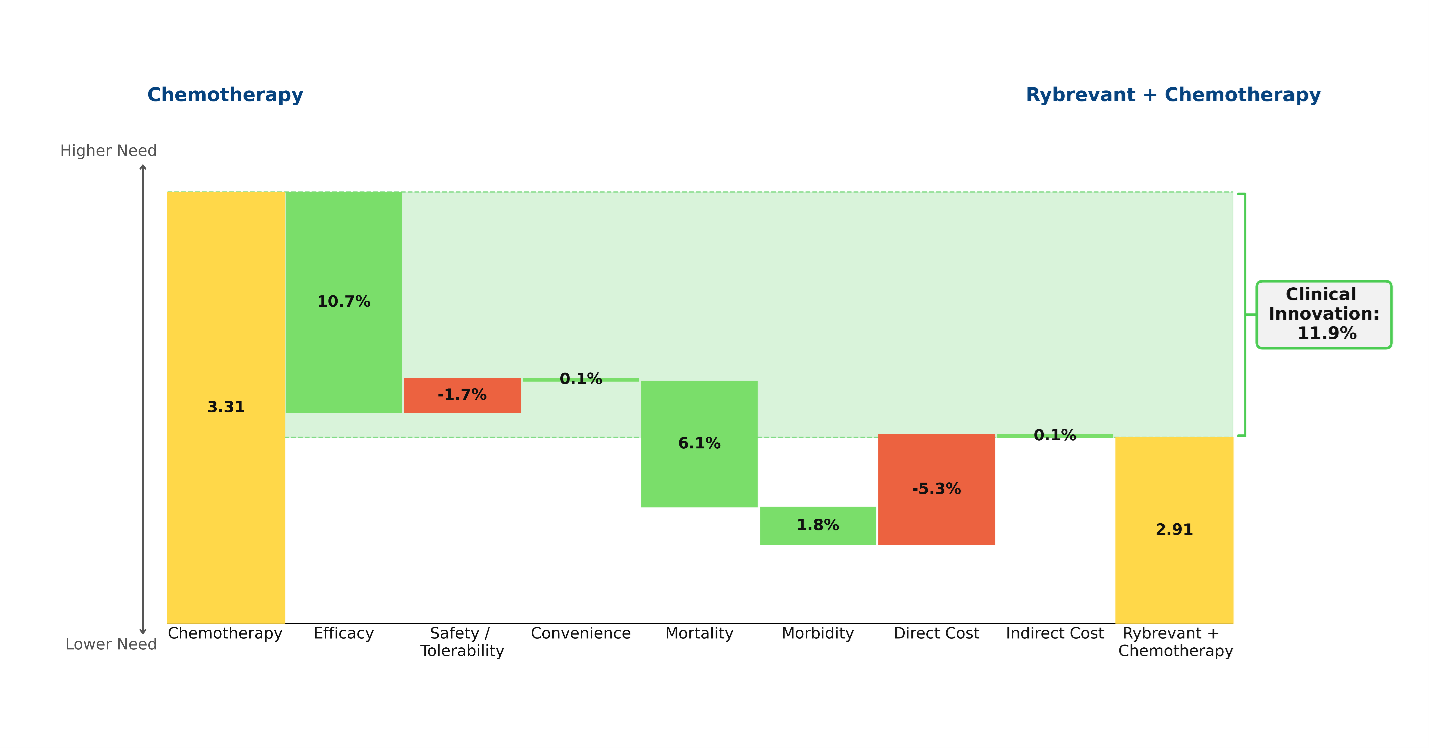
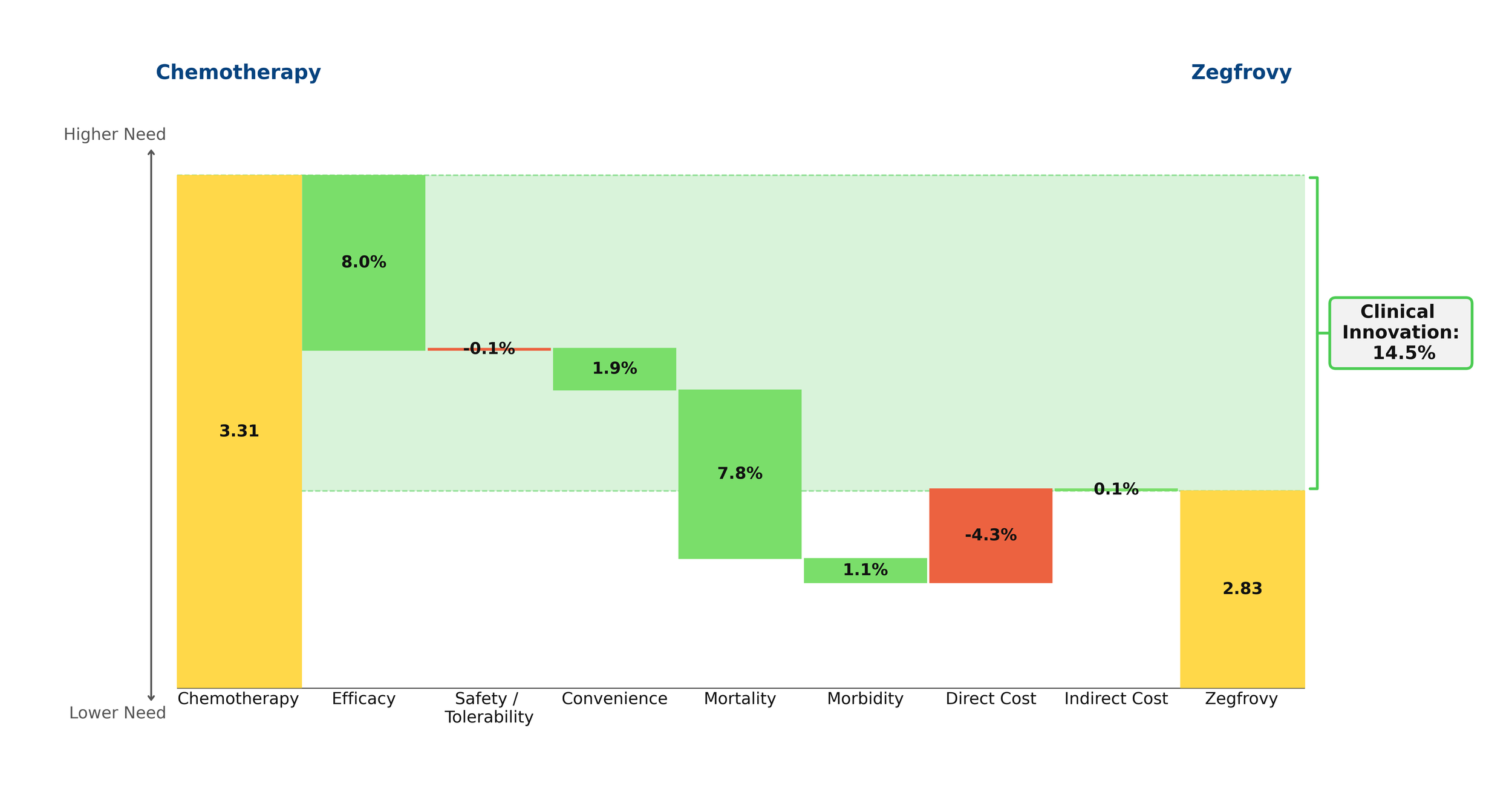
Figure 1: Drivers of Clinical Innovation for Rybrevant + chemotherapy and Zegfrovy when compared to chemotherapy alone
The catch is that Rybrevant has been on the market for over 5 years now and has been 1L standard of care since 2024. AstraZeneca, who recently submitted an sNDA for a 1L label expansion and is expected to commercialize Zegfrovy in the 2L setting in Q4 2026, has an uphill battle in translating this modest differentiation into market share.
[1] van Veggel B, Madeira R Santos JFV, Hashemi SMS, et al. Osimertinib treatment for patients with EGFR exon 20 mutation positive non-small cell lung cancer. Lung Cancer. 2020;141:9-13. doi:10.1016/j.lungcan.2019.12.011
[2] Zhou C, Greillier L, Liu G, et al. First-line sunvozertinib in NSCLC with EGFR exon 20 insertion mutations. N Engl J Med. 2026;395(8):765-775. doi:10.1056/NEJMoa2604461
[3] Zhou C, Tang KJ, Cho BC, et al. Amivantamab plus chemotherapy in NSCLC with EGFR exon 20 insertions. N Engl J Med. 2023;389(22):2039-2051. doi:10.1056/NEJMoa2306441
[4] OncLive Staff. PAPILLON: Frontline amivantamab plus chemotherapy yields 34.3-month median OS in EGFR exon 20 insertion–positive NSCLC. OncLive. September 13, 2026. Accessed September 30, 2026. https://www.onclive.com/view/frontline-amivantamab-chemotherapy-34-3-month-median-os-egfr-exon-20-insertion-nsclc-papillon